


Over 80% of global trade by volume moves through maritime routes, making each major ocean route a vital part of international commerce. Knowing how these routes operate can impact delivery timelines, coordination, and shipping costs for supply chain managers, logistics directors, procurement leads, and operations teams.
Managing shipments across high-traffic ocean routes involves more than choosing the shortest path. It requires consistent visibility, accurate data, and a quick response to disruptions.
Real-time container tracking solutions like Vizion provide port activity insights and integrations that keep operations moving with fewer surprises.
What is an Ocean Route?
An ocean route is a strategic shipping path across international waters that connects key ports worldwide. These routes are essential for moving cargo efficiently between production centers, consumer markets, and resource hubs.
- Purpose: Ocean routes are designed to streamline shipping operations, reduce transit times, and cut transportation costs.
- Scope: They can range from short feeder routes between regional ports to extensive global passages like the Trans-Pacific route.
- Impact: The effectiveness of a shipping route can influence overall logistics performance, affecting delivery timelines, costs, and cargo security.
What Makes an Ocean Route Important?
Not all ocean routes carry the same significance. Major routes stand out due to their strategic importance, high trade volumes, and connectivity to major global markets. Here are the key criteria that make an ocean route essential:
- Geography: Routes like the Panama Canal and Suez Canal offer shortcuts that significantly reduce travel distance.
- Access: Straits like Hormuz and Malacca act as chokepoints for global energy shipments, making them indispensable for fuel transport.
- Infrastructure: Routes connected by modern ports and terminals can handle larger vessels and higher cargo volumes, improving efficiency.
- Trade Volume: High-traffic routes like the Dover Strait facilitate the movement of massive cargo volumes between major economies, making them economically vital.
10 Major Ocean Routes Powering Global Trade
Ocean routes are vital corridors for moving goods across continents, connecting production centers, consumer markets, and resource-rich regions. Here are ten major ocean routes that play a crucial role in global shipping:
1. Panama Canal Route
The Panama Canal is a 51-mile man-made waterway linking the Atlantic and Pacific Oceans. It dramatically reduces the vessels' travel time. Completed in 1914, it remains one of the most critical passages for international shipping.
- By bypassing Cape Horn, the canal saves vessels 2,000 to 8,000 nautical miles per voyage.
- Handles over 259 million metric tons of cargo annually, including crude oil, grains, and chemicals.
2. Suez Canal Route
Stretching 193 km through the Isthmus of Suez, this artificial waterway connects the Mediterranean and Red Seas, offering the fastest route for trade between Europe and Asia.
- Approximately 19,000 ships transit the canal annually, moving 12% of global trade.
- Essential for transporting oil and LNG from the Middle East to Europe, accounting for 7-8% of the world’s oil trade.
3. Dover Strait (English Channel)
Located between the U.K. and France, the Dover Strait is one of the busiest shipping lanes in the world. It serves as a gateway to Northern Europe.
- Nearly 500 vessels pass through each day, carrying goods between the Atlantic, North Sea, and Baltic Sea.
- Reduces shipping time from 210 minutes to 90 minutes, making it a preferred route for European trade.
4. St. Lawrence Seaway
This 600 km system of locks and canals connects the Atlantic Ocean to the Great Lakes, facilitating direct trade between Canada and the U.S.
- Enables vessels to reach inland ports like Duluth and Chicago, moving bulk goods like iron ore, grain, and mining products.
- Handles 40-50 million tonnes of cargo annually, making it a vital trade corridor for North American exports.
5. Strait of Malacca
The Strait of Malacca spans 800 km and is a crucial link between the Indian and Pacific Oceans. It serves as the main trade route for Asian economies.
- Nearly 50,000 ships transit the strait annually, carrying essential commodities like coal, palm oil, and LNG.
- Provides the shortest path between the Persian Gulf and major Asian ports, including those in China, Japan, and South Korea.
6. Strait of Hormuz
Positioned between the Persian Gulf and the Gulf of Oman, this narrow passage is one of the world’s most strategic chokepoints for oil and gas shipments.
- Around 25% of global oil exports and one-third of LNG shipments pass through annually, making it a critical route for Asian economies.
- Strict traffic management systems are in place to prevent collisions and maintain the flow of vessels through the strait.
7. Strait of Gibraltar
Connecting the Atlantic Ocean to the Mediterranean Sea, this 13 km passage separates Europe from Africa and is a vital route for oil and gas shipments.
- Facilitates cargo movement between major ports in Spain, Morocco, and Gibraltar, including large oil tankers.
- Also, a key route for migrant vessels and smaller cargo ships poses security and regulatory challenges.
8. Danish Straits
A series of narrow passages connecting the Baltic Sea to the North Sea allows vessels to move between Northern Europe and global markets.
- Handles over 3.2 million barrels of crude oil daily, making it a critical route for Russian oil exports to Europe.
- Divided into three main channels: Fehmarn Belt, Oresund, and Great Belt, each with varying levels of cargo capacity.
9. Bosphorus Strait
Situated in Turkey, the Bosphorus connects the Black Sea to the Sea of Marmara, forming a vital commercial and military route.
- Spanning just 31 km, it is one of the narrowest yet busiest shipping lanes, handling a mix of cargo ships, oil tankers, and passenger vessels.
- Its strategic location provides Black Sea nations, including Russia and Ukraine, with sea access to global markets.
10. Trans-Pacific Route
The Trans-Pacific route connects Asia with North and South America, facilitating large-scale trade across the world’s largest ocean.
- The route is divided into the North Pacific and South Pacific lanes. It serves major ports like Shanghai, Tokyo, Los Angeles, and Long Beach.
- Handles vast quantities of containerized cargo, including electronics, machinery, and manufactured goods, making it a key corridor for transcontinental trade.
Key Challenges in Ocean Route Shipping and Their Solutions
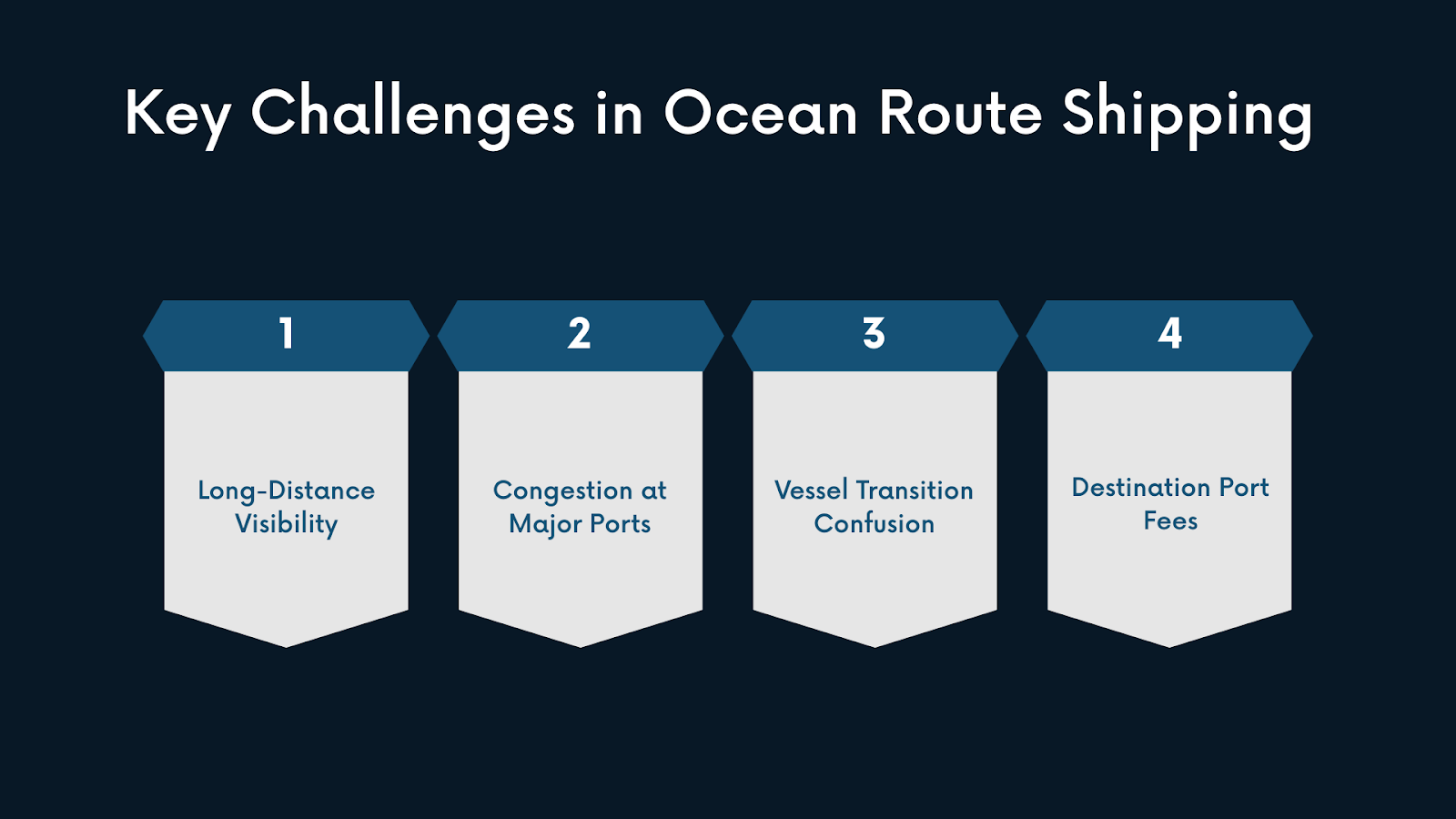
Shipping across global ocean routes involves more than just navigating from port to port. Vessels encounter unpredictable delays, limited visibility, and coordination challenges that can disrupt timelines and inflate costs.
Here are some of the most pressing challenges faced by importers and logistics teams, and how solutions like Vizion can help mitigate them:
1. Visibility Gaps Over Long Distances
Ocean routes span vast distances, often with little to no visibility on cargo status between ports. Without timely updates, logistics teams are left guessing about container locations and estimated arrival times.
- Vizion Solution: Real-time container tracking provides consistent updates throughout the shipping journey, allowing stakeholders to monitor cargo status across multiple ocean routes. This minimizes guesswork and enables better planning.
2. Congestion at Major Ports
High-traffic routes like the Suez Canal, Panama Canal, and Dover Strait are notorious for congestion, causing issues that can significantly delay shipments. These chokepoints disrupt schedules and increase transit times.
- Vizion Solution: Port performance and port activity data from Vizion deliver insights into congestion levels at key ports, enabling logistics teams to adjust routes, reschedule pickups, or anticipate potential delays more effectively.
3. Confusion During Vessel Transitions
Cargo often changes vessels or carriers during long-haul routes, especially on transhipment-heavy passages. Miscommunication during these transitions can lead to misplaced or misrouted containers.
- Vizion Solution: Standardized tracking milestones provide precise, actionable data on every container move, reducing confusion and ensuring accurate handoffs between vessels. This maintains cargo visibility, even when containers switch vessels at transhipment hubs.
4. Unexpected Fees at Destination Ports
Shippers may incur demurrage and detention fees if cargo remains at destination ports longer than anticipated. These charges can add up quickly, especially in high-congestion ports.
- Vizion Solution: Last Free Date and available for pickup alerts from Vizion notify shippers when containers are ready for collection, helping to avoid unnecessary fees and streamline drayage coordination.
Conclusion
Understanding major ocean routes and their strategic importance can transform how businesses manage global shipments. These routes connect key markets and offer critical shortcuts that reduce transit times and costs.
However, navigating these high-traffic passages comes with challenges, from maintaining visibility across long distances to mitigating delays at congested ports. Reliable tracking and data-driven insights are essential to ensuring smooth, efficient cargo movement across these global corridors.
Vizion provides solutions that keep businesses informed at every stage of the journey, from real-time container tracking to comprehensive port performance data.
- Real-Time Container Tracking: Gain access to the most complete, standardized, and detailed container tracking events via API or user interface with real-time container data.
- TradeView: Monitor the live flow of any company's shipments 30 to 90 days before arrival at the destination and analyze trends across 10 years of historical supplier, product, and logistics movement data. With 900 million shipment records, 140+ attributes per shipment, coverage spanning 190 countries, and comprehensive HS code data, TradeView empowers data-driven decisions that optimize global trade management.
- Logistics Performance Hub: Access a comprehensive suite of global logistics datasets, including Port Performance, Port Activity, and Port Pairs, to analyze shipping trends, port throughput, container dwell times, and real-time port activity, enabling smarter decision-making about containerized freight movements.
%20-%202026-09-17T163139.307.png)
%20-%202026-08-26T095403.692.png)
%20-%202026-08-24T110906.499.png)


