Back to Resources

How Many Containers Can a Container Ship Carry?

May 23, 2025

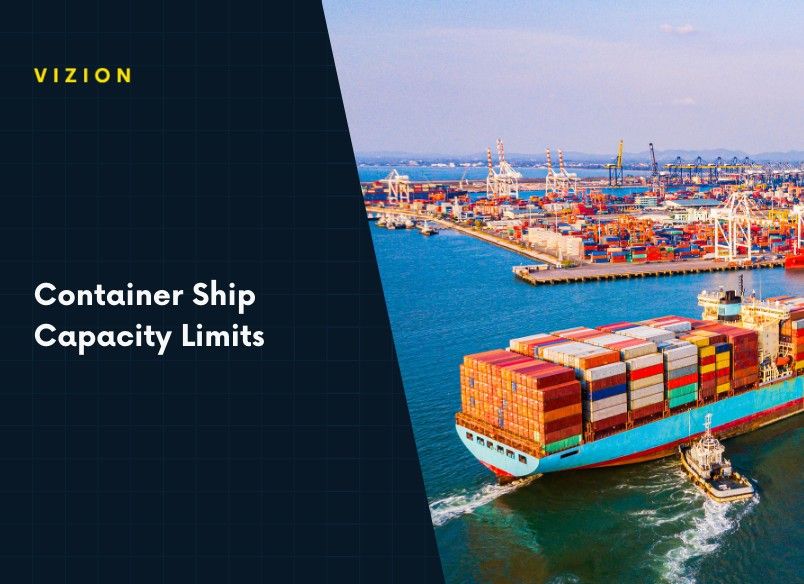
Container ships are vital to global trade, moving goods across oceans and powering supply chains worldwide. According to reports, the global container shipping fleet could grow to more than 31.4 million TEU, an annual increase of 10%.

Understanding the capacity of these ships is essential for optimizing shipping routes, port operations, and logistics planning. Knowing how many containers a container ship can carry directly impacts shipping costs, efficiency, and scheduling, making it a key factor for businesses managing global trade.

What is a Container Ship?

A container ship is specifically designed to transport standardized containers securely and efficiently. It is built to maximize space, minimize handling, and ensure that goods are transported safely across oceans.

Container ships are crucial to the global supply chain because they facilitate rapid, secure, and cost-effective movement of goods. Here’s why container ships are essential to international shipping:

  • Global Connectivity: Container ships connect different regions of the world, making it possible to move goods between continents quickly.
  • Cost-Effectiveness: They reduce the cost per unit of cargo, making international trade more affordable and accessible.
  • Speed and Efficiency: With advanced design and large carrying capacity, container ships can transport massive amounts of goods in a single trip, improving overall shipping efficiency.
  • Security: The standardized containers ensure that goods are transported securely, reducing the risk of damage and theft.

Average Number of Containers on a Ship

The number of containers a ship can carry varies significantly based on size and design. Modern container ships have an average capacity of 4,580 TEUs (Twenty-foot Equivalent Units), nearly double the average capacity from 2006 due to the rise of larger vessels exceeding 12,000 TEUs.

  • Smaller Feeder Ships: Typically carry around 600 TEUs, ideal for regional routes and smaller ports.
  • Panamax Ships: Designed for the original Panama Canal dimensions, they can handle up to 5,000 TEUs.
  • Post-Panamax Ships: Larger vessels can transport 8,000 and 12,000 TEUs, mainly serving major international routes.
  • Ultra-large container Vessels (ULCVs): These are the giants of the industry, capable of carrying over 24,000 TEUs, such as the MSC Irina.

Factors Affecting Container Capacity
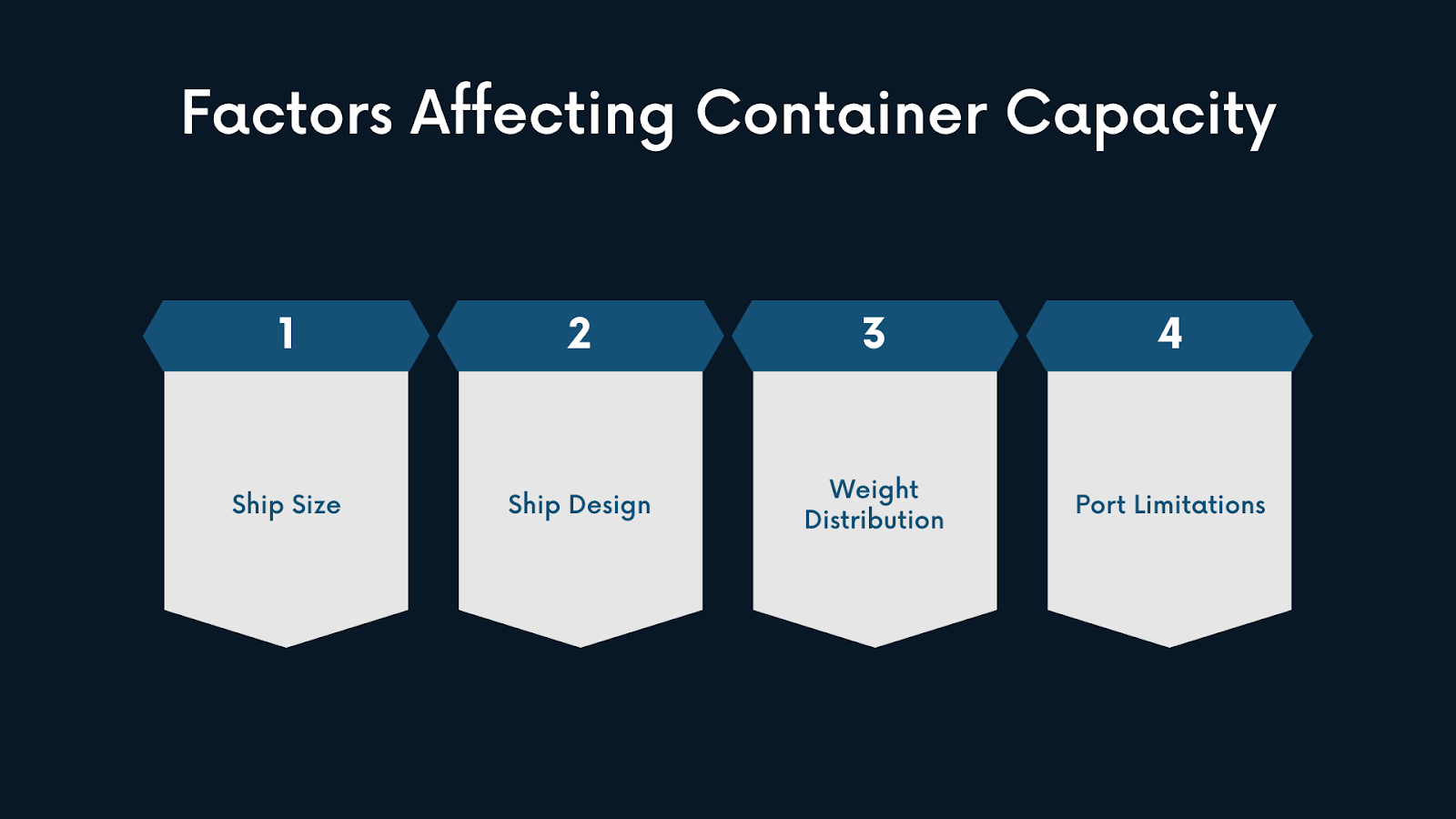
The container capacity of a ship is primarily influenced by several key factors. These factors determine how much cargo the vessel can carry, directly impacting operational efficiency and shipping costs.

1. Ship Size

Larger ships generally have the capacity to carry more containers.

  • Length and Width: The overall size of the ship, particularly its length and width, determines how many rows and stacks of containers can be accommodated.
  • Height of the Ship: Taller ships with higher clearance between decks allow for more container layers, increasing capacity.

2. Ship Design

The design of the ship plays a crucial role in maximizing container space.

  • Number of Decks: Ships with multiple decks can stack containers higher, increasing their total carrying capacity.
  • Cell Guides: Cell guides organize containers into vertical stacks, ensuring efficient use of available space.

3. Weight Distribution

Maintaining proper weight distribution is essential for safely loading containers while maximizing capacity.

  • Even Weight Load: Containers must be distributed evenly across the ship to maintain balance. Uneven loading can compromise stability and reduce the total number of containers that can be safely carried.
  • Max Load Limits: The ship's maximum load limit, based on its design and weight distribution, can affect the total number of containers that can be loaded without exceeding the safe operational weight.

4. Port Limitations

The size and infrastructure of the ports the ship can access influence the number of containers that can be loaded or unloaded.

  • Dock Size and Depth: Ports with shallow depths or smaller docks can only accommodate smaller ships, limiting the container capacity that can be accessed at these ports.
  • Crane Capacity: Ports equipped with larger cranes and better handling infrastructure can load and unload more containers at once, allowing for higher capacity utilization.

6 Types of Container Ships and Their Capacities
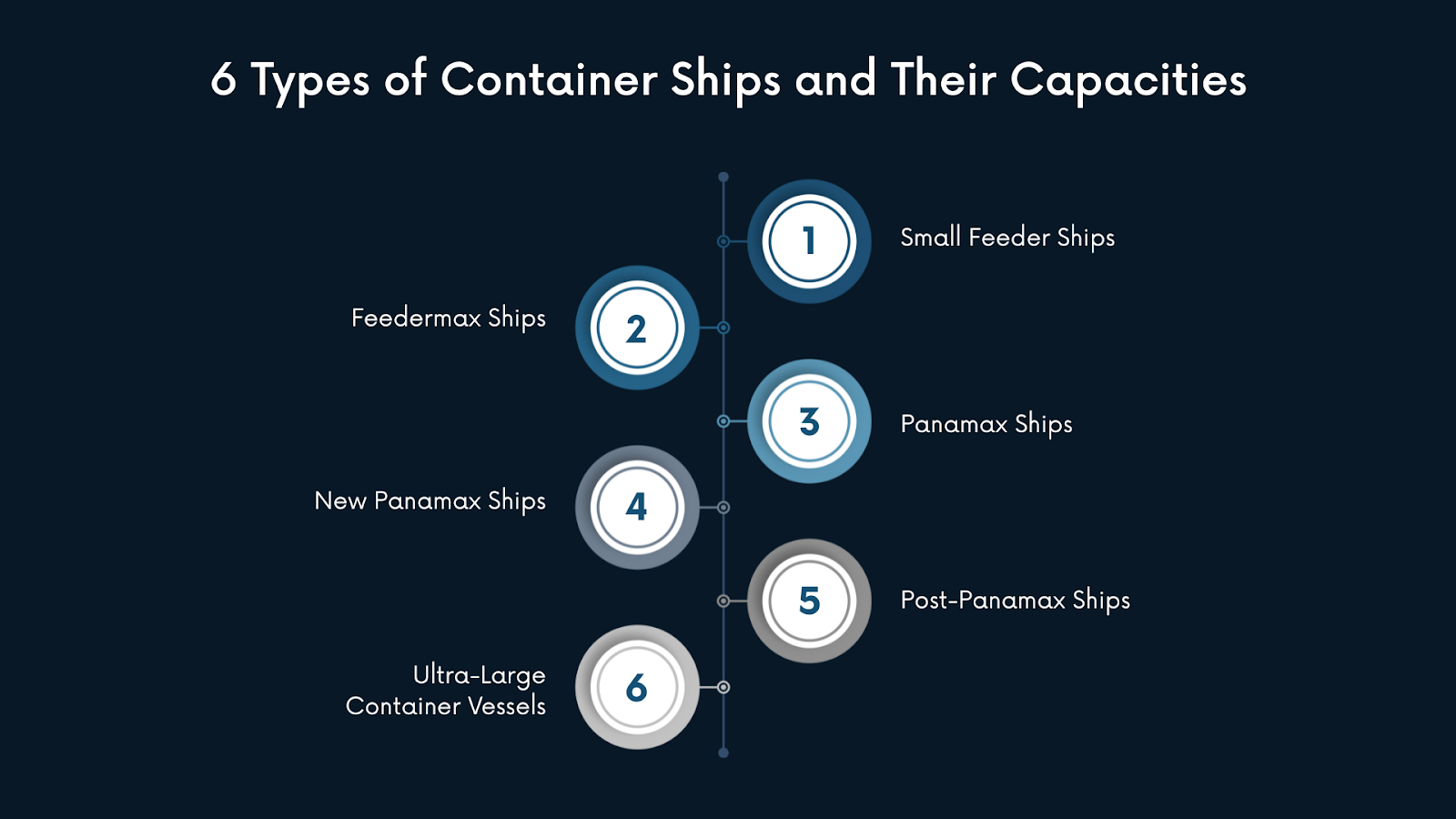
Each type of container ship is designed to serve specific routes and ports, and the design and purpose of the vessel influence its capacity. Let’s look at the various types and the number of containers they typically carry.

1. Small Feeder Ships

Small feeder ships are the smallest in container shipping, typically carrying between 1,000 and 3,000 TEUs. These ships are vital for regional trade and smaller port operations.

  • Role: Serve smaller regional ports, facilitating cargo transfer from larger vessels to inland areas or smaller ports.
  • Flexibility: Ideal for shorter routes where port infrastructure is limited. These ships can access ports that larger vessels can't, offering flexibility in regional shipping.

2. Feedermax Ships

Feedermax ships are slightly larger than standard feeder ships, with a capacity of up to 3,000 TEUs. They typically operate in larger inland ports and handle specialized cargo.

  • Role: Operate in larger inland ports, like the Baltic Sea, helping connect smaller ports to major international routes.
  • Specialized Shipments: These ships can also transport specialty goods, including hazardous materials with unusual sizes that don't fit in standard containers.

3. Panamax Ships

Panamax ships are designed to fit through the original Panama Canal and typically hold around 5,000 TEUs. Their design makes them essential to global trade routes, particularly between the Atlantic and Pacific Oceans.

  • Design for the Canal: Built to the exact specifications of the original Panama Canal, they are ideal for trade routes that require passage through this key waterway.
  • Capacity: Generally carries around 5,000 TEUs, making them a workhorse for medium-range global routes.

4. New Panamax Ships

Following the 2016 expansion of the Panama Canal, New Panamax ships, also called Neopanamax ships, were built to fit the expanded dimensions of the canal. These vessels can carry up to 12,500 TEUs.

  • Increased Capacity: The expansion of the Panama Canal allows these ships to transport larger quantities of goods through the canal, bypassing the long journey around Cape Horn.
  • Efficiency: Their larger capacity enables more efficient transport of goods, reducing shipping costs for long-distance international trade.

5. Post-Panamax Ships

Post-Panamax ships are larger than the original Panamax and can carry between 8,000 and 12,000 TEUs. They are typically used for high-volume global trade and are common on major international routes.

  • Global Trade: These ships are designed for large-scale global routes, typically linking major international ports like those in Asia, Europe, and North America.
  • Capacity: With a larger capacity than Panamax, they can carry more containers, making them ideal for high-demand shipping lanes.

6. Ultra-Large Container Vessels (ULCVs)

Ultra-large container vessels (ULCVs) are the giants of the shipping industry, carrying over 21,000 TEUs. They are used on high-volume international routes and are the largest vessels in operation.

  • Massive Capacity: With a capacity of 21,000 TEUs or more, ULCVs can transport vast amounts of goods across oceans in a single journey.
  • High-Volume Routes: Typically used on major trade lanes between Asia and Europe or Asia and North America, these ships maximize efficiency by carrying large quantities of cargo on long-distance routes.

Real-World Container Ship Examples
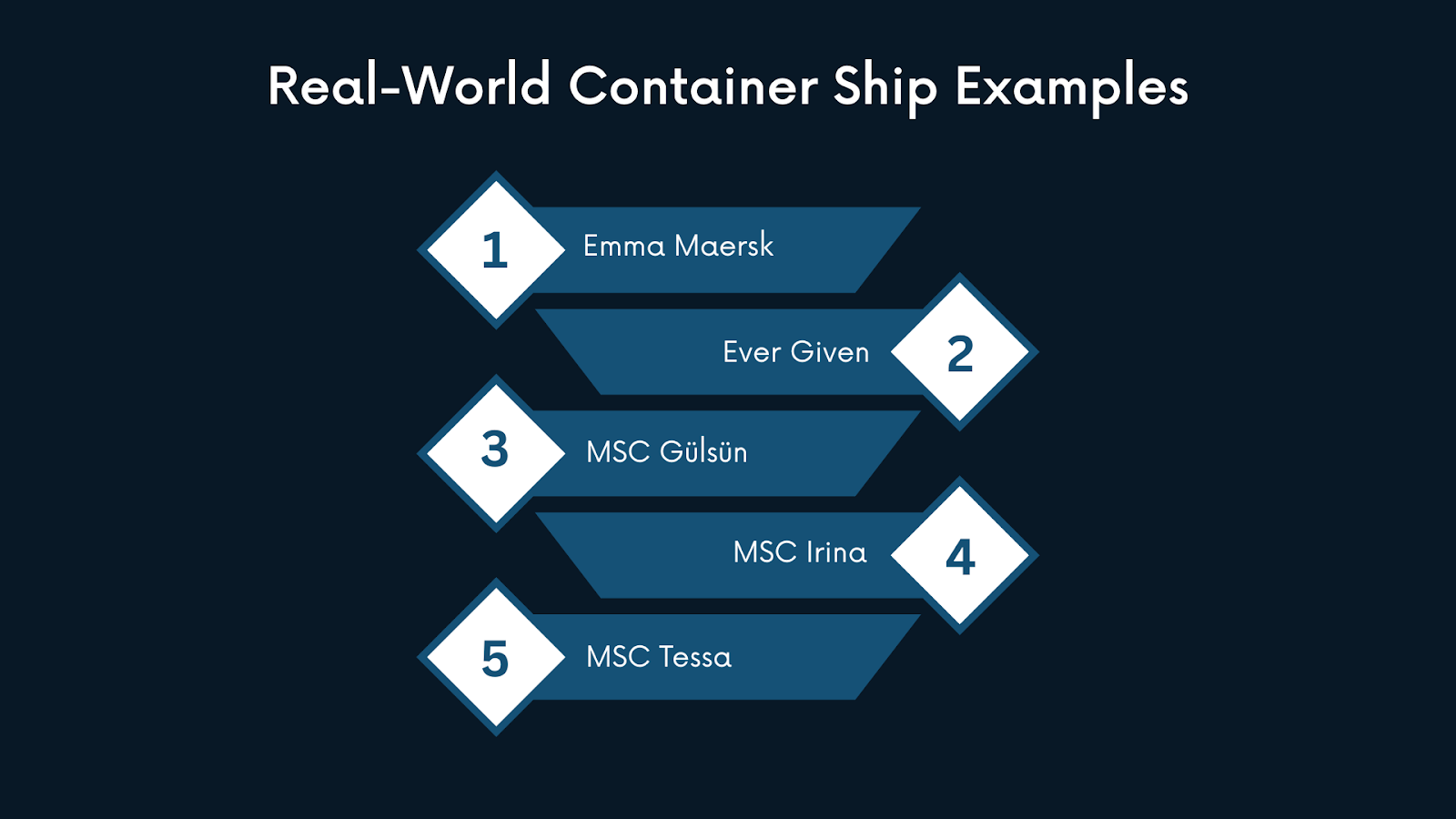
To provide a clearer picture of container ship capacities, here are some notable real-life examples of vessels and how much cargo they can carry. These ships represent the forefront of container transportation, showcasing the immense scale of modern shipping.

1. Emma Maersk

The Emma Maersk is part of Maersk Line’s Triple E-class and is known for its enormous cargo capacity.

  • TEU Capacity: Can carry between 13,500 and 15,000 TEUs.
  • Design: The Emma Maersk is one of the largest container ships in the world, offering highly efficient cargo handling and fuel economy.

2. Ever Given

The Ever Given is widely known for its role in the 2021 Suez Canal blockage, but its impressive capacity is often overlooked.

  • TEU Capacity: Can carry up to 20,124 TEUs.
  • Cargo Variety: The ship is versatile, carrying various products across continents, including furniture, electronics, and industrial goods.

3. MSC Gülsün

The MSC Gülsün is one of the largest container ships in operation, known for its capacity and innovative design.

  • TEU Capacity: Can carry up to 23,756 TEUs.
  • Design: The ship allows 24 rows of containers, optimizing space for efficient cargo transport.

4. MSC Irina

The MSC Irina holds the record for being the world’s largest container ship.

  • TEU Capacity: Capable of carrying over 24,300 TEUs.
  • Record-Breaking Size: As of January 2024, it is the largest container ship in the world, setting new standards in shipping capacity.

5. MSC Tessa

The MSC Tessa is another massive shipping vessel known for its efficiency and sheer size.

  • TEU Capacity: Capable of carrying 24,116 TEUs.
  • Efficiency: It’s designed for high-volume, long-distance international routes, improving logistics efficiency and reducing shipping costs.

Conclusion

Container ships are vital to global trade, transporting goods across oceans and connecting economies worldwide. Their varying capacities help keep the flow of goods efficient, reducing costs and enhancing supply chain operations.

As container shipping evolves, real-time tracking becomes essential for managing these shipments. Vizion’s real-time container tracking solution ensures you can track shipments accurately, optimize port operations, and reduce delays. By offering easy integration and precise tracking data, Vizion helps businesses improve operational efficiency and make smarter decisions.

Book a demo with Vizion:

FAQs

Q1. How does container ship capacity impact shipping costs?

A1. The capacity of a container ship directly influences shipping costs by determining how much cargo can be transported in a single trip. Larger vessels can carry more containers, reducing the cost per unit shipped. However, if the ship is not fully loaded, costs may increase due to underutilization of space.

Q2. What role does container tracking play in managing ship capacity?

A2. Accurate container tracking helps logistics teams monitor how effectively ship capacity is utilized. Real-time visibility into container locations allows for better cargo load planning, minimizing empty space, and optimizing overall shipping efficiency.

Q3. Are there specific ports that handle more high-capacity container ships?

A3. Major international ports are equipped to handle ultra-large container vessels (ULCVs) with capacities exceeding 24,000 TEUs. Ports with advanced infrastructure, deeper berths, and high-capacity cranes are more likely to accommodate these larger ships effectively.

Q4. How can tracking container capacity trends help in logistics planning?

A4. Monitoring container capacity trends allows logistics managers to anticipate potential congestion at major ports, align shipping schedules with vessel availability, and adjust routing plans to optimize load efficiency and reduce transit times.

Get the Most Advanced Visibility into the Journey of Your Ocean and Rail Containers

Talk to one of our supply chain experts to get started now.

Talk to an Expert

Thank you for your submission!

A member of the Vizion team will be in touch shortly.
Oops! Something went wrong while submitting the form.

Talk to an Expert

Thank you for your submission!

A member of the Vizion team will be in touch shortly.
Oops! Something went wrong while submitting the form.
close modal icon

Book a Demo

Are you ready to experience the many benefits of container visibility? Schedule a VIZION API demo today.

Thank you for your submission!

A member of the Vizion team will be in touch shortly.
Oops! Something went wrong while submitting the form.
close modal icon

How Many Containers Can a Container Ship Carry?

May 23, 2025

Container ships are vital to global trade, moving goods across oceans and powering supply chains worldwide. According to reports, the global container shipping fleet could grow to more than 31.4 million TEU, an annual increase of 10%.

Understanding the capacity of these ships is essential for optimizing shipping routes, port operations, and logistics planning. Knowing how many containers a container ship can carry directly impacts shipping costs, efficiency, and scheduling, making it a key factor for businesses managing global trade.

What is a Container Ship?

A container ship is specifically designed to transport standardized containers securely and efficiently. It is built to maximize space, minimize handling, and ensure that goods are transported safely across oceans.

Container ships are crucial to the global supply chain because they facilitate rapid, secure, and cost-effective movement of goods. Here’s why container ships are essential to international shipping:

  • Global Connectivity: Container ships connect different regions of the world, making it possible to move goods between continents quickly.
  • Cost-Effectiveness: They reduce the cost per unit of cargo, making international trade more affordable and accessible.
  • Speed and Efficiency: With advanced design and large carrying capacity, container ships can transport massive amounts of goods in a single trip, improving overall shipping efficiency.
  • Security: The standardized containers ensure that goods are transported securely, reducing the risk of damage and theft.

Average Number of Containers on a Ship

The number of containers a ship can carry varies significantly based on size and design. Modern container ships have an average capacity of 4,580 TEUs (Twenty-foot Equivalent Units), nearly double the average capacity from 2006 due to the rise of larger vessels exceeding 12,000 TEUs.

  • Smaller Feeder Ships: Typically carry around 600 TEUs, ideal for regional routes and smaller ports.
  • Panamax Ships: Designed for the original Panama Canal dimensions, they can handle up to 5,000 TEUs.
  • Post-Panamax Ships: Larger vessels can transport 8,000 and 12,000 TEUs, mainly serving major international routes.
  • Ultra-large container Vessels (ULCVs): These are the giants of the industry, capable of carrying over 24,000 TEUs, such as the MSC Irina.

Factors Affecting Container Capacity

The container capacity of a ship is primarily influenced by several key factors. These factors determine how much cargo the vessel can carry, directly impacting operational efficiency and shipping costs.

1. Ship Size

Larger ships generally have the capacity to carry more containers.

  • Length and Width: The overall size of the ship, particularly its length and width, determines how many rows and stacks of containers can be accommodated.
  • Height of the Ship: Taller ships with higher clearance between decks allow for more container layers, increasing capacity.

2. Ship Design

The design of the ship plays a crucial role in maximizing container space.

  • Number of Decks: Ships with multiple decks can stack containers higher, increasing their total carrying capacity.
  • Cell Guides: Cell guides organize containers into vertical stacks, ensuring efficient use of available space.

3. Weight Distribution

Maintaining proper weight distribution is essential for safely loading containers while maximizing capacity.

  • Even Weight Load: Containers must be distributed evenly across the ship to maintain balance. Uneven loading can compromise stability and reduce the total number of containers that can be safely carried.
  • Max Load Limits: The ship's maximum load limit, based on its design and weight distribution, can affect the total number of containers that can be loaded without exceeding the safe operational weight.

4. Port Limitations

The size and infrastructure of the ports the ship can access influence the number of containers that can be loaded or unloaded.

  • Dock Size and Depth: Ports with shallow depths or smaller docks can only accommodate smaller ships, limiting the container capacity that can be accessed at these ports.
  • Crane Capacity: Ports equipped with larger cranes and better handling infrastructure can load and unload more containers at once, allowing for higher capacity utilization.

6 Types of Container Ships and Their Capacities

Each type of container ship is designed to serve specific routes and ports, and the design and purpose of the vessel influence its capacity. Let’s look at the various types and the number of containers they typically carry.

1. Small Feeder Ships

Small feeder ships are the smallest in container shipping, typically carrying between 1,000 and 3,000 TEUs. These ships are vital for regional trade and smaller port operations.

  • Role: Serve smaller regional ports, facilitating cargo transfer from larger vessels to inland areas or smaller ports.
  • Flexibility: Ideal for shorter routes where port infrastructure is limited. These ships can access ports that larger vessels can't, offering flexibility in regional shipping.

2. Feedermax Ships

Feedermax ships are slightly larger than standard feeder ships, with a capacity of up to 3,000 TEUs. They typically operate in larger inland ports and handle specialized cargo.

  • Role: Operate in larger inland ports, like the Baltic Sea, helping connect smaller ports to major international routes.
  • Specialized Shipments: These ships can also transport specialty goods, including hazardous materials with unusual sizes that don't fit in standard containers.

3. Panamax Ships

Panamax ships are designed to fit through the original Panama Canal and typically hold around 5,000 TEUs. Their design makes them essential to global trade routes, particularly between the Atlantic and Pacific Oceans.

  • Design for the Canal: Built to the exact specifications of the original Panama Canal, they are ideal for trade routes that require passage through this key waterway.
  • Capacity: Generally carries around 5,000 TEUs, making them a workhorse for medium-range global routes.

4. New Panamax Ships

Following the 2016 expansion of the Panama Canal, New Panamax ships, also called Neopanamax ships, were built to fit the expanded dimensions of the canal. These vessels can carry up to 12,500 TEUs.

  • Increased Capacity: The expansion of the Panama Canal allows these ships to transport larger quantities of goods through the canal, bypassing the long journey around Cape Horn.
  • Efficiency: Their larger capacity enables more efficient transport of goods, reducing shipping costs for long-distance international trade.

5. Post-Panamax Ships

Post-Panamax ships are larger than the original Panamax and can carry between 8,000 and 12,000 TEUs. They are typically used for high-volume global trade and are common on major international routes.

  • Global Trade: These ships are designed for large-scale global routes, typically linking major international ports like those in Asia, Europe, and North America.
  • Capacity: With a larger capacity than Panamax, they can carry more containers, making them ideal for high-demand shipping lanes.

6. Ultra-Large Container Vessels (ULCVs)

Ultra-large container vessels (ULCVs) are the giants of the shipping industry, carrying over 21,000 TEUs. They are used on high-volume international routes and are the largest vessels in operation.

  • Massive Capacity: With a capacity of 21,000 TEUs or more, ULCVs can transport vast amounts of goods across oceans in a single journey.
  • High-Volume Routes: Typically used on major trade lanes between Asia and Europe or Asia and North America, these ships maximize efficiency by carrying large quantities of cargo on long-distance routes.

Real-World Container Ship Examples

To provide a clearer picture of container ship capacities, here are some notable real-life examples of vessels and how much cargo they can carry. These ships represent the forefront of container transportation, showcasing the immense scale of modern shipping.

1. Emma Maersk

The Emma Maersk is part of Maersk Line’s Triple E-class and is known for its enormous cargo capacity.

  • TEU Capacity: Can carry between 13,500 and 15,000 TEUs.
  • Design: The Emma Maersk is one of the largest container ships in the world, offering highly efficient cargo handling and fuel economy.

2. Ever Given

The Ever Given is widely known for its role in the 2021 Suez Canal blockage, but its impressive capacity is often overlooked.

  • TEU Capacity: Can carry up to 20,124 TEUs.
  • Cargo Variety: The ship is versatile, carrying various products across continents, including furniture, electronics, and industrial goods.

3. MSC Gülsün

The MSC Gülsün is one of the largest container ships in operation, known for its capacity and innovative design.

  • TEU Capacity: Can carry up to 23,756 TEUs.
  • Design: The ship allows 24 rows of containers, optimizing space for efficient cargo transport.

4. MSC Irina

The MSC Irina holds the record for being the world’s largest container ship.

  • TEU Capacity: Capable of carrying over 24,300 TEUs.
  • Record-Breaking Size: As of January 2024, it is the largest container ship in the world, setting new standards in shipping capacity.

5. MSC Tessa

The MSC Tessa is another massive shipping vessel known for its efficiency and sheer size.

  • TEU Capacity: Capable of carrying 24,116 TEUs.
  • Efficiency: It’s designed for high-volume, long-distance international routes, improving logistics efficiency and reducing shipping costs.

Conclusion

Container ships are vital to global trade, transporting goods across oceans and connecting economies worldwide. Their varying capacities help keep the flow of goods efficient, reducing costs and enhancing supply chain operations.

As container shipping evolves, real-time tracking becomes essential for managing these shipments. Vizion’s real-time container tracking solution ensures you can track shipments accurately, optimize port operations, and reduce delays. By offering easy integration and precise tracking data, Vizion helps businesses improve operational efficiency and make smarter decisions.

Book a demo with Vizion:

FAQs

Q1. How does container ship capacity impact shipping costs?

A1. The capacity of a container ship directly influences shipping costs by determining how much cargo can be transported in a single trip. Larger vessels can carry more containers, reducing the cost per unit shipped. However, if the ship is not fully loaded, costs may increase due to underutilization of space.

Q2. What role does container tracking play in managing ship capacity?

A2. Accurate container tracking helps logistics teams monitor how effectively ship capacity is utilized. Real-time visibility into container locations allows for better cargo load planning, minimizing empty space, and optimizing overall shipping efficiency.

Q3. Are there specific ports that handle more high-capacity container ships?

A3. Major international ports are equipped to handle ultra-large container vessels (ULCVs) with capacities exceeding 24,000 TEUs. Ports with advanced infrastructure, deeper berths, and high-capacity cranes are more likely to accommodate these larger ships effectively.

Q4. How can tracking container capacity trends help in logistics planning?

A4. Monitoring container capacity trends allows logistics managers to anticipate potential congestion at major ports, align shipping schedules with vessel availability, and adjust routing plans to optimize load efficiency and reduce transit times.

Talk to an Expert

Book A Demo

Are you ready to experience the many benefits of container visibility? Schedule a VIZION API demo today.

close icon
Only valid business email addresses.
Please include country code.
Thank you! Your submission has been received!
Oops! Something went wrong while submitting the form.