


%20(62).png)
The latest TradeView Live episode brought together Kyle Henderson, CEO & Co-Founder of Vizion, and Robert Kirk, Head of Analytics Global Product at Dun & Bradstreet, for an in-depth discussion on the World Trade Organization’s October 2025 Global Trade Outlook. This episode unpacked what’s really behind recent trade slowdowns, revealing how forward-looking data helps spot market shifts before they hit headlines.
From falling Chinese exports and a reshuffling of global supply chains to weakening business confidence and muted forecasts for 2026, the discussion combined data from TradeView, Dun & Bradstreet, and the WTO to reveal how markets are shifting.“The goal isn’t more data — it’s more insight,” Kirk said. “We’re living through functional disruption: geopolitical change, AI transformation, and policy volatility, all happening faster than ever.”
Weekly TradeView data for the week of October 6 showed:
- Global bookings: Down 10% year over year, up 10% week over week
- U.S. imports: Down nearly 20% year over year, with a small week-over-week rise
- China → U.S. bookings: Large year-over-year drop but a strong rebound after Golden Week
To explore how these trends have avolved across the full year, visit Vizion's 2025 Tariff Tracker - an ongoing dataset highlighting booking shifts across various trade lanes.
.png)
China’s week-long holiday caused a predictable dip in bookings, followed by a sharp recovery as shippers rushed to secure space ahead of November 1 tariff enforcement. Henderson noted this could represent a “policy reaction spike".So where is China shipping instead? TradeView’s data shows rising exports to:
- Thailand
- Vietnam
- Malaysia
Robert Kirk added that while “commerce finds a way,” greater diversification introduces more counterparties and therefore more risk across the supply chain.

Global Trade Outlook: Flattening Growth, Persistent Front-Loading
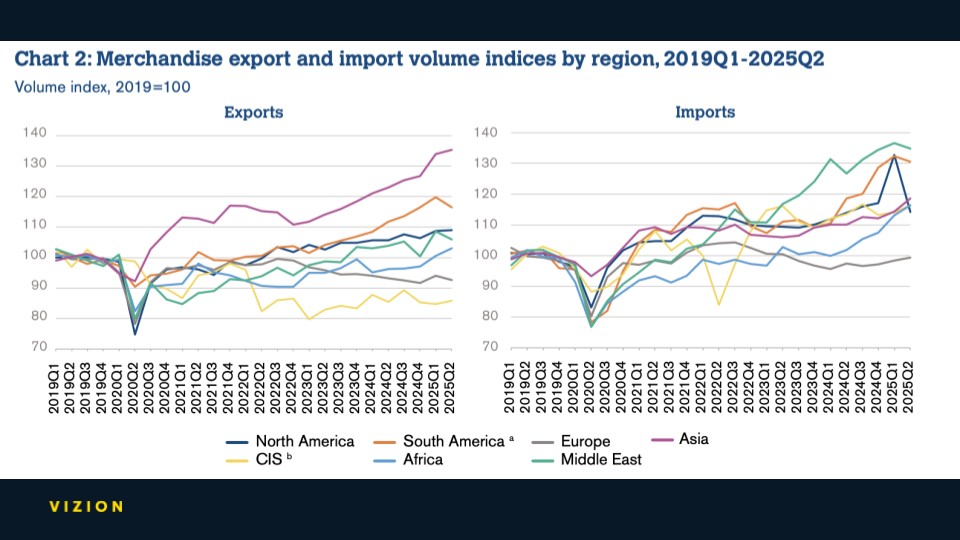
The WTO’s Global Container Throughput Index reflects broad regional differences:
- Asia’s exports continue upward despite tariff pressures.
- North America’s imports show a steep surge at the end of 2024 followed by a sharp decline in 2025, a classic case of front-loading.
- Europe’s exports remain mostly flat.
- Africa’s imports are rising, signaling that discounted Chinese goods are finding new markets.
Robert emphasized that even with U.S. volumes flattening, the index remains above 2019 levels, suggesting resilience behind the headlines.
These shifts are already reflected in the WTO’s latest data, which show a world trade system recalibrating under the weight of tariffs and uncertainty.
The WTO projects global merchandise trade volume growth slowing to 0.5% in 2026 (down from 1.8%).Dun & Bradstreet’s forecast, however, remains cautiously positive. Kirk described their view as “continued but modest growth” across most markets. Henderson highlighted J.P. Morgan’s $1.5 trillion initiative to strengthen supply chain resiliency as a possible wildcard. “This kind of investment could accelerate the next phase of growth if it’s deployed quickly enough to reshape manufacturing and infrastructure.”
.png)
TradeView container import bookings by region
*Interactive: Scroll or hover to see weekly TEU volumes for each year
“When you look at import volumes by region, you can see how front-loading and tariff responses really show up in North America,” said Kyle Henderson. “That spike at the end of 2024 and the sharp drop after—those are the effects of companies racing to get goods in before policy changes. What’s interesting is that no other region shows that same pattern. Asia keeps climbing steadily, Europe stays fairly flat, and you can see Africa and South America gradually rising as new demand centers emerge.” This chart captures the broader theme of the WTO’s 2025 outlook: trade is not collapsing, but recalibrating. While North America experiences pronounced swings tied to policy shifts, other regions are showing steadier growth, suggesting that global demand continues to find new paths for movement.
Conclusion: A Global System in Recalibration
The latest WTO outlook, supported by TradeView booking data, shows a world trade system adjusting to new realities. China’s slowing exports, shifting supply chains, and softer forecasts for 2026 point to a period of recalibration rather than retreat. Despite headwinds from tariffs and policy uncertainty, resilience remains visible in the data. As Robert Kirk noted, “commerce finds a way.” Real-time booking intelligence from platforms like TradeView now makes it possible to see those shifts as they happen—before they reach the headlines.
Get Ahead with Early Trade Intelligence
Vizion’s TradeView platform gives you live visibility into:
- Booking trends by country, product type, HS code, or commodity
- Changes by country or port
- Shipment behavior by consignee, shipper, and logistics provider
%20-%202026-10-07T150316.660.png)
%20-%202026-09-17T163139.307.png)
%20-%202026-08-26T095403.692.png)


