


%20(59).png)
The Global Journey of Denim: Levi's Supply Chain Diversification 🌍🧵
Levi Strauss & Co., creator of blue jeans, is experiencing a major resurgence, with its stock up over 40% this year. New collections, including 90s-style loose jeans, and a Beyoncé campaign have boosted its appeal to younger consumers. The company's direct-to-consumer division now accounts for almost half of revenues, and Levi's shows resilience against tariffs, with only 1% of products from China. Overseas sales make up about three-fifths of total revenue, and investors are optimistic about continued strong performance.
For over 170 years, Levi Strauss & Co. has been synonymous with American denim, its iconic blue jeans becoming a global symbol of rugged individualism and timeless style. Yet, behind this enduring image, the story of how their jeans are made has undergone massive and transformative changes.
Driven by a confluence of powerful forces, including the relentless march of globalization, intense market competition, and the disruptive impact of recent global crises, the company's supply chain has evolved dramatically. What was once a largely US-centric model, with manufacturing concentrated domestically, has expanded exponentially to become a vast, intricate, and geographically dispersed global network. This shift reflects not only the economic realities of modern manufacturing but also Levi Strauss & Co.'s strategic adaptation to maintain its competitive edge and meet the demands of a worldwide consumer base.
Levi’s Sourcing Over the Past 24 Months (2023-09-30 ~ 2025-10-09)
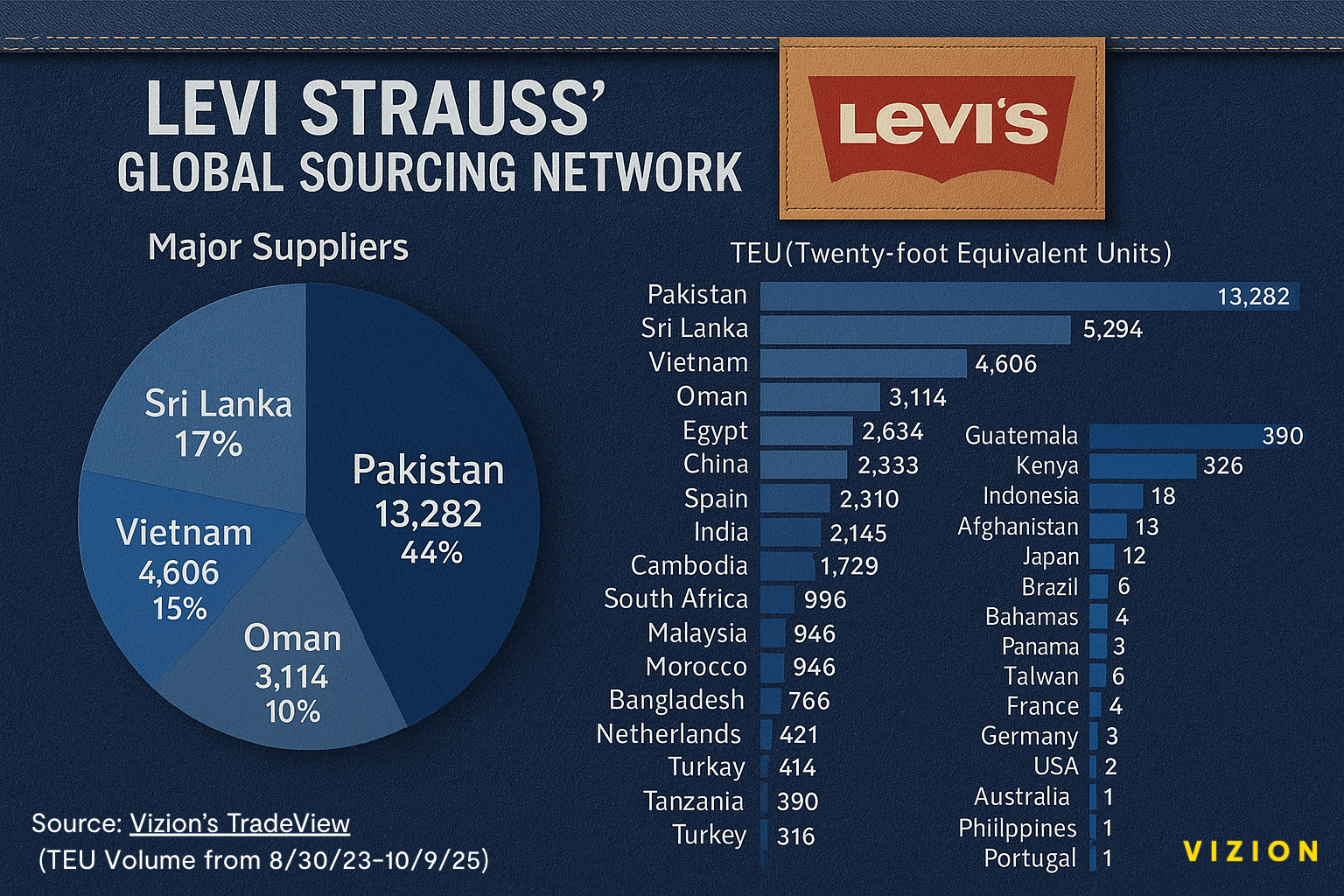
Here is a decade-by-decade look at how Levi's diversified its production and sourcing.
1960s–1980s: The Dawn of Global Expansion
While Levi's maintained significant US manufacturing, the seeds of global operations were planted as early as the 1960s.
- The 1960s: As the "blue jeans craze" took off, the popularity of Levi's products led the company to begin setting up offices and factories across Europe and Asia. This marked the initial phase of diversifying production beyond US borders to meet surging international demand.
- The 1980s: This decade saw the start of structural changes in American fashion manufacturing. As cheaper imports entered the market, the US manufacturing base began to contract, setting the stage for more dramatic offshoring in the next decade.
1990s: The Watershed Decade of Offshoring
The 1990s were the most significant period for diversifying Levi's production base, transforming the company's manufacturing landscape.
- Massive Offshoring: Facing intense competition and pressure to lower costs, Levi's began accelerating the pace of its US factory closures and heavily shifted production to offshore subcontractors.
- Emerging Sourcing Hubs: The company began sourcing production from developing countries across Asia, including China, Vietnam, Indonesia, India, Bangladesh, and Sri Lanka. This was a pivotal move to take advantage of lower production costs and cheaper labor, fundamentally diversifying its supply chain geographically.
- Ethical Sourcing Pioneer (1991): Amid this global shift, Levi's was the first multinational apparel company to establish a comprehensive Global Terms of Engagement (TOE)—a workplace code of conduct for its manufacturing suppliers. This pioneering move set the standard for ethical sourcing that is now common in the industry.
2000s–2010s: Agility and Risk Mitigation
With its supply chain firmly established across multiple continents, the focus shifted toward optimizing this vast network and mitigating new geopolitical risks.
- Further Globalization: Levi's continued to expand its global sourcing network, utilizing contractors in numerous countries.
- Reducing Reliance on China (Late 2010s): Due to mounting global trade uncertainties and tariffs, Levi's made a strategic decision to drastically reduce its manufacturing reliance on China. Manufacturing sourced from China dropped from 16% in 2017 to approximately 1–2% by 2019, showcasing a deliberate diversification to mitigate single-country risk.
- Sustainable Sourcing: The company ramped up efforts to diversify its raw material sourcing to include more sustainable alternatives, such as the introduction of "cottonized hemp" in its Wellthread™ line in 2019.
2020s: The Era of Resilience and Nearshoring
The COVID-19 pandemic and subsequent global supply chain crises highlighted the need for even greater resilience and agility, leading to a new phase of diversification.
- The Resilience Mandate: CEO Chip Bergh famously declared that the trend of chasing the "lowest-cost manufacturing base around the world" was ending, making "supply chain resilience and agility" the new name of the game.
- Hyper-Diversification: By the early 2020s, Levi's was sourcing products from more than 500 supplier facilities across approximately 40 countries, allowing the company to quickly shift production and shipping routes (e.g., diverting freight to the US East Coast to avoid West Coast congestion).
- Reshoring for High-End: While global sourcing continues to dominate, Levi's has resumed the production of some of its higher-end, more expensive styles of jeans in the US, partly driven by a trend toward domestic production for high-value goods.
- Product Diversification: The supply chain also supported massive product diversification with the acquisition of Beyond Yoga in 2021, instantly adding activewear production and materials (stretchy fabrics) to its sourcing needs.
👉 Interested in other supplier data? Request access or schedule a demo directly below.
%20-%202026-09-17T163139.307.png)
%20-%202026-08-26T095403.692.png)
%20-%202026-08-24T110906.499.png)


