


.jpg)
The Acceleration of Nearshoring: U.S. to Mexico Trade Shifts in 2024
The shift towards nearshoring has been a topic of growing interest in global trade discussions. As companies seek to mitigate supply chain disruptions and impacts from tariffs, the movement of trade from Asia and other global markets away from the US toward Mexico has gained significant traction. This trend is reflected in our latest analysis on TEU (twenty-foot equivalent unit) volume shifts between the US and Mexico. Our analysis of consignee, port of lading, product, and shipper-level data reveals key trends that provide valuable insights into the reshaping of North American supply chains.
On April 2nd, the US is set to impose a 25% tariff increase on goods imported from Mexico. This sudden policy change will have immediate and far-reaching consequences for manufacturers, shippers, and supply chain planners, altering cost structures and forcing companies to reassess their sourcing strategies.
For businesses that have already moved production closer to home, this could be a wake-up call to fine-tune supply chain efficiency and ensure they are maximizing the benefits of near-shoring. For others, this tariff spike may serve as a tipping point, making it essential to analyze whether nearshoring can provide a more stable and cost-effective alternative to overseas manufacturing.
Why Nearshoring? Nearshoring is not a new concept, but its adoption has accelerated due to geopolitical tensions, supply chain bottlenecks, and economic incentives. The advantages of shifting production and trade closer to the US include:
- Shorter Lead Times: Mexico’s proximity allows for quicker transit compared to shipments from Asia.
- Cost Reductions: Lower tariffs, reduced transportation costs, and tax incentives have made Mexico a favorable alternative.
- Trade Agreements: The United States-Mexico-Canada Agreement (USMCA) enhances trade cooperation and provides stability.
- Diversification of Supply Chains: Companies are mitigating risks associated with over-reliance on a single region.
Our sample set analysis below looks at TEU 2023 to 2024 volume change across four categories: Consignee, Port of Lading (POL), Product, and Shipper. Vizion offers a clearer picture of how nearshoring is manifesting in containerized trade flows.
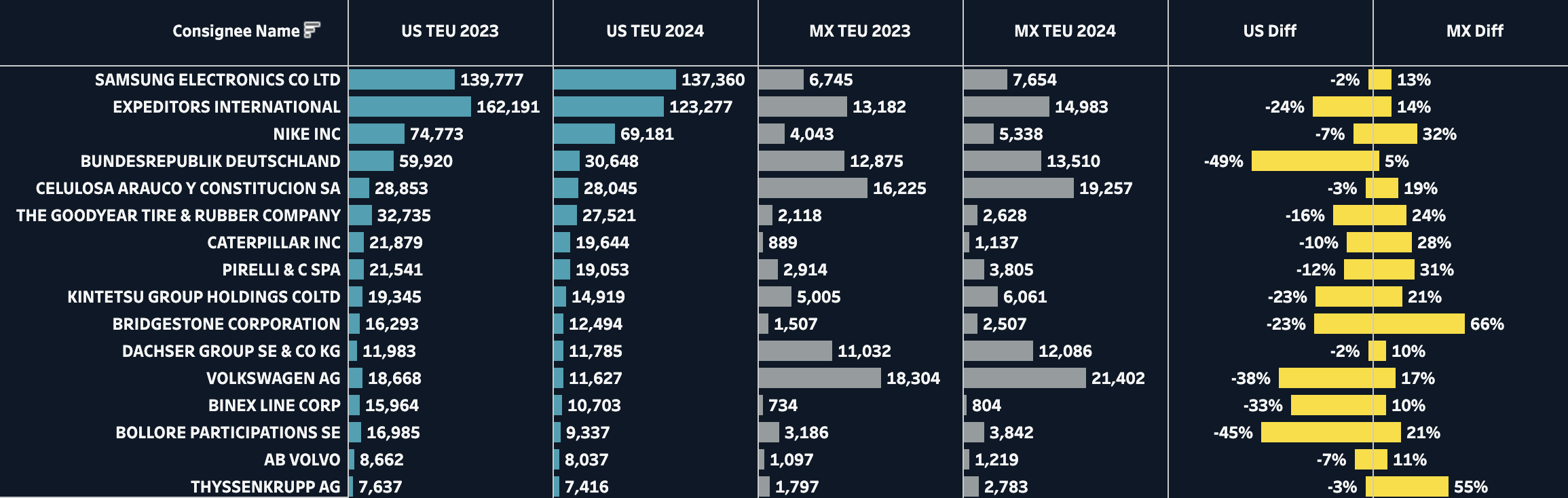
Key Findings by Consignee
Analyzing the TEU data by consignee, we identified notable shifts in trade away from the U.S. to Mexico.
- Major Port Diversions – Companies like Volkswagen, Samsung, and Nissan reduced US TEUs while increasing shipments to Mexico, reflecting a shift in trade routes.
- Broad Nearshoring Adoption – Growth spans automotive, electronics, and manufacturing, with firms like Thyssenkrupp and Pirelli reallocating volumes to Mexico.
- Expanding Mexico Logistics – Mexico is experiencing increased TEU flows, underscoring Mexico’s rising port capacity.
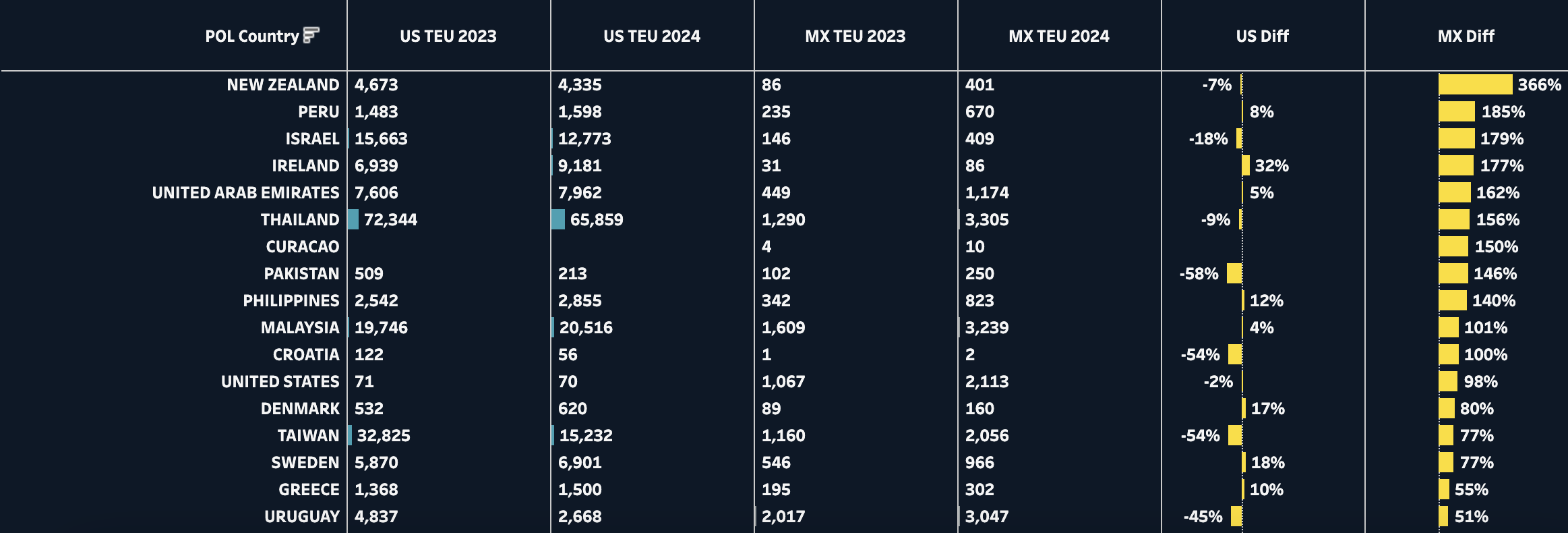
Key Findings by Port of Lading
Analyzing the TEU data by the departure country of origin, we identified notable shifts in trade away from the US to Mexico.
- Major Port Diversions – Ports in the US that historically handled significant container traffic saw decreased volume, while their Mexican counterparts experienced growth. This indicates a strategic reallocation of shipping routes in favor of near-shoring.
- Near-shoring Gains from Diverse Origins - The highest growth in TEU share into Mexico came from a diverse set of origin companies that suggests near-shoring is not limited to a single trade lane but is being driven by global realignment.
- Sustained Growth in Mexican Port Infrastructure – Countries like Malaysia, Taiwan, and Thailand traditionally major importers to the US saw notable increases in TEU volumes to Mexico.
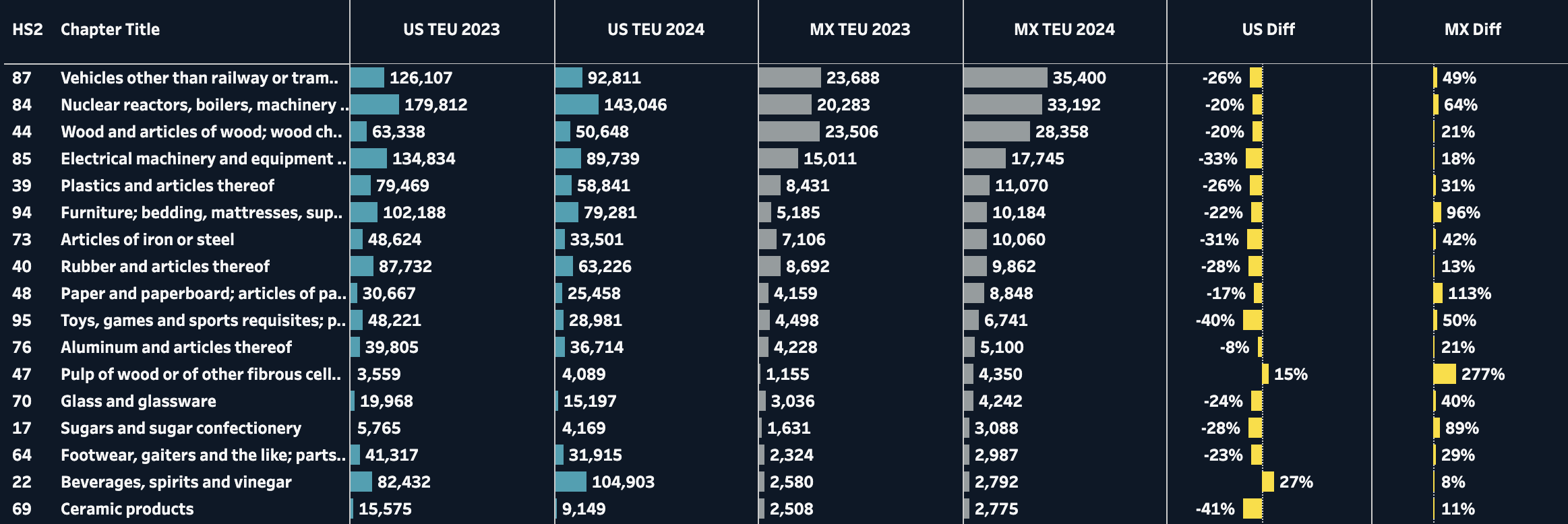
Key Findings by Product Category
A breakdown of trade by product category provides insight into which industries are making the strongest push toward near-shoring.
- Electronics and Machinery Are Leading the Shift – High-tech industries, particularly electronics and industrial machinery, show a sharp decline in US TEU share while growing in Mexico.
- Consumer Goods Are Moving Faster Than Raw Materials – While some agricultural products remain in traditional US routes, finished consumer goods such as automotive components and household appliances are shifting to Mexico.
- Processed Foods and Packaging + Heavy Manufacturing and Construction Materials Seeing Rising Trends – Some food and beverage sectors continue to favor US routes, though overall, processed food shipments to Mexico are on the rise.
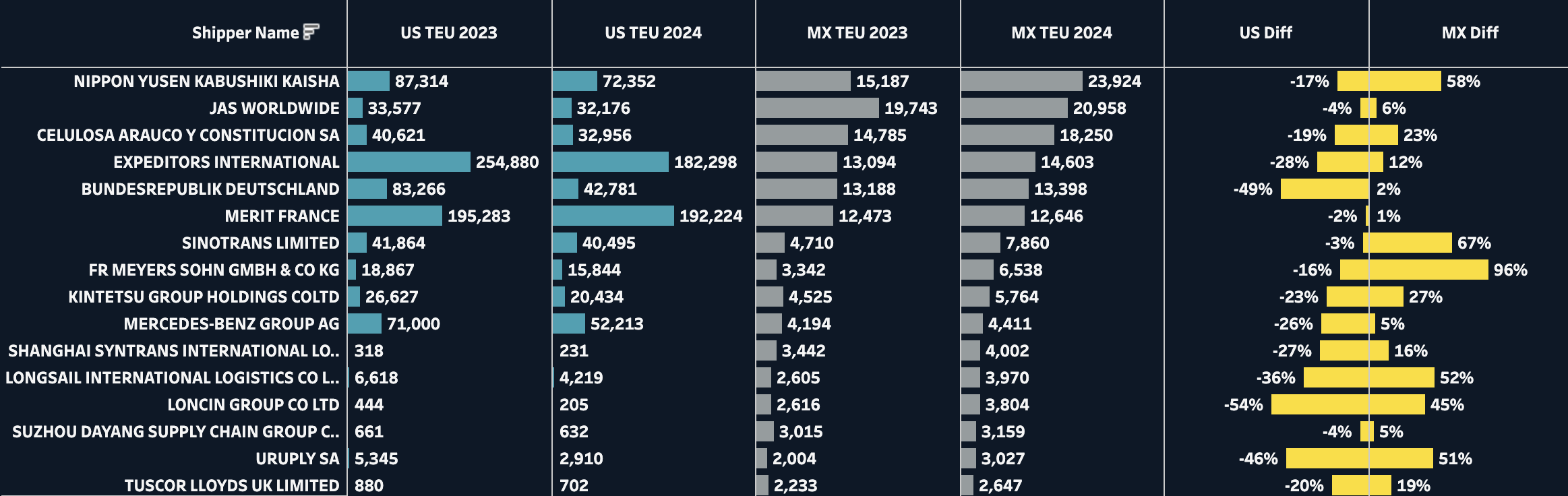
Key Findings by Named Shipper
Examining shifts at the shipper level reveals which major exporters are driving this near-shoring movement.
- Global Logistics Providers Are Leading the Transition – Companies like Nippon Yusen and Sinotrans Limited are diverting volumes indicating that large freight forwarders are aligning with near-shoring trends.
- Shippers of Industrial and Raw Materials Are Accelerating Their Shift - Wood, paper and industrial materials are being increasingly sourced through Mexico.
- Retail-Focused Companies Are Adopting Near-shoring Strategies – Large consumer brands are moving manufacturing closer to end consumers, reducing dependency on distant supply chains.
Conclusion - The data clearly shows that nearshoring is not just a theoretical shift, but it is happening in real time. As companies seek more resilient and cost-effective supply chains, Mexico is emerging as a critical trade partner in ways that will shape the future of North American logistics. The continued evolution of this trend will depend on further investments in infrastructure, policy changes, and shifts in corporate strategy. Businesses that recognize these patterns and adapt accordingly will be best positioned to capitalize on the efficiencies of nearshoring in 2024 and beyond.
Get the Data You Need to Make Informed Decisions
In times of shifting trade policies and economic uncertainty, data-driven insights are critical. If your business is evaluating the impact of this new tariff or considering near-shoring as a strategy, we can provide a custom analysis and reporting tailored to your supply chain needs.
Schedule time with us ➡️ https://meetings.hubspot.com/ben-tracy to access a detailed dataset on nearshoring trends and trade flows helping you make informed decisions in real time.
%20-%202026-08-26T095403.692.png)
%20-%202026-08-24T110906.499.png)
%20-%202026-08-06T110951.366.png)


