Back to Resources

Supply Chain Visibility Market Size and Trends

May 30, 2025

The supply chain visibility market size is poised for a significant expansion. Ongoing global upheavals have revealed serious shortcomings in transparency, risk management, and the ability to respond quickly to changes.

Companies are rapidly adopting advanced technologies like AI-driven analytics and modern execution tools to boost real-time visibility, reduce delays, and eliminate blind spots in their supply chains.

Meanwhile, concerns like cybersecurity attacks, worker shortages, and political instability are compelling companies to focus on building resilience and diversifying their supplier base.

As the demand for end-to-end visibility intensifies, the market is projected to reach $30.91 billion by 2026. Explore the key trends transforming supply chain management and learn how to future-proof your operations in an increasingly volatile landscape.

What is Supply Chain Visibility?

Supply Chain Visibility, or SCV,  refers to the ability of a business to track, monitor, and manage products, components, and shipments as they move through each stage of the supply chain from suppliers to manufacturers to end customers. It involves real-time access to critical data across all touchpoints, enabling informed decision-making and proactive responses to disruptions.

SCV comes down to a few crucial things:

  • Real-time tracking of goods and materials.
  • Data sharing across systems and partners.
  • Transparency into inventory levels, order status, and supplier performance.
  • Predictive analytics to identify and mitigate risks before they escalate.

When you’ve got a solid handle on your supply chain, it makes your business run smoother. It also saves you money, keeps your customers happier, and helps you weather any storms that might come your way globally.

Why is Supply Chain Visibility Important?

When supply chains lack end-to-end visibility, companies are forced to make high-stakes decisions based on partial or outdated data. This often results in avoidable inefficiencies, missed growth opportunities, and greater exposure to unexpected disruptions and challenges that could be mitigated with real-time, connected insights.

A recent survey by Eide Bailly found that 45% of mid-market manufacturers and distributors have taken steps to enhance their supply chain visibility in the past year. The reason is apparent: greater transparency supports more thoughtful planning, faster response times, and better cost control. Benefits include:

  • We can save money by getting better at planning our inventory and using less of that costly expedited shipping.
  • Stronger forecasting to ensure optimal stock levels across all locations.
  • Streamlined operations that maximize efficiency and productivity.
  • Improved risk management across globally interconnected supply networks.
  • Better supplier and customer relationships, driven by data and trust.
  • Enhanced decision-making, informed by real-time, actionable insights.

According to the Supply Chain Visibility Software Market Report, the global market size reached USD 1.92 billion in 2024. Moreover, it is projected to surge to USD 15.93 billion by 2033, growing at a CAGR of 26.45%. This growth reflects an urgent industry push to reduce blind spots and strengthen operational resilience through real-time tracking and data integration.

11 Supply Chain Management Trends That Can Make A Difference
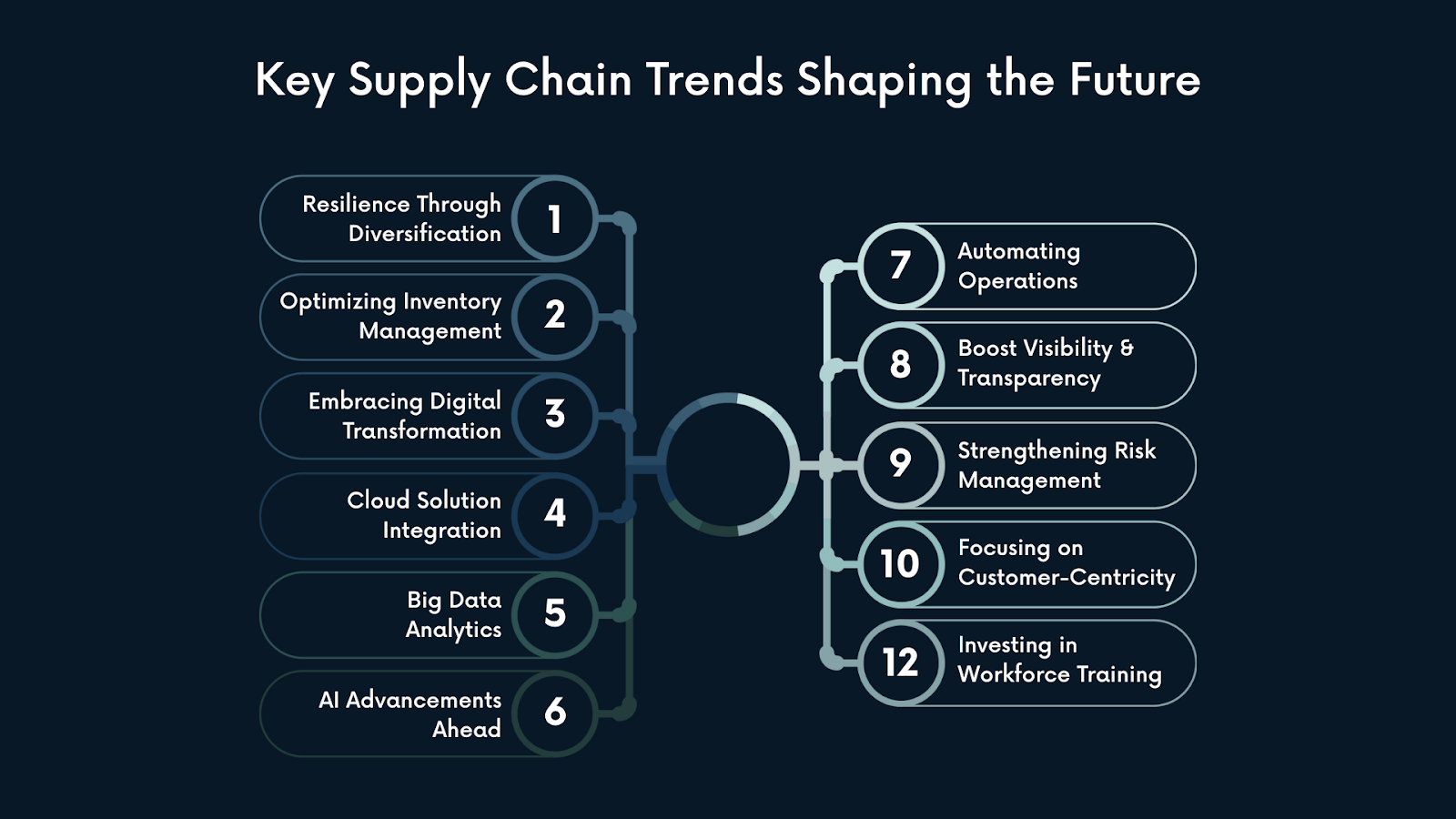
<info graphics>

Supply chains are multiplying, driven by technological advancements, shifting consumer expectations, and global challenges. Here’s a concise overview of the key trends shaping the landscape:

1. Building Resilience Through Diversification

Companies are reconfiguring their supply chains to enhance resilience. This involves diversifying suppliers, embracing nearshoring and onshoring, and adopting multishoring strategies to mitigate risks associated with geopolitical tensions and transportation bottlenecks.

2. Optimizing Inventory Management

The traditional "just-in-time" inventory approach is being reimagined. Businesses are now balancing lean inventories with safety stocks, termed "just-right" inventories, to navigate potential disruptions and fluctuating consumer demands.

3. Embracing Digital Transformation

Digital tools are central to modern supply chain operations. Technologies like AI-driven forecasting, cloud-based platforms, and real-time inventory systems are enhancing efficiency, customer experience, and responsiveness to market changes.

4. Incorporating Cloud-Based Solutions

Cloud computing has become the backbone of supply chain software. It facilitates data integration, real-time access, and innovations like digital twins, enabling better decision-making and operational orchestration.

5. Harnessing Big Data and Analytics

The integration of IoT devices, historical data, and market insights allows for advanced analytics. This data-driven approach improves demand forecasting, inventory management, and overall supply chain planning.

6. Advancing with Artificial Intelligence

AI is revolutionizing supply chain management. From optimizing customer experiences to forecasting demand and identifying disruptions, AI tools are enhancing efficiency and decision-making capabilities.

7. Automating Operations

Automation is streamlining supply chain processes. Technologies like robotic process automation (RPA) and AI-powered tools are reducing manual tasks, increasing accuracy, and improving response times.

8. Enhancing Visibility and Transparency

Achieving end-to-end visibility remains a priority. Tools like AI-enhanced transparency solutions and blockchain are being deployed to trace raw materials, ensure ethical sourcing, and meet regulatory requirements.

9. Strengthening Risk Management

Companies are prioritizing risk management by implementing scenario planning and enhancing traceability. These measures help in anticipating disruptions and ensuring compliance with evolving regulations.

10. Focusing on Customer-Centricity

Supply chains are becoming more customer-focused. This involves capitalizing on technologies for accurate demand forecasting, personalization, and transparency to enhance customer satisfaction and loyalty.

11. Investing in Workforce Training

Due to ongoing labor shortages, businesses are putting money into training their staff and automating processes. They’re using technologies like generative AI to help employees, boost efficiency, and tackle staffing issues.

These shifts really show how supply chains are constantly changing in 2025, emphasizing the need for flexibility, using technology, and focusing on the customer.

Major Market Challenges Impacting Global Trade

A convergence of geopolitical, environmental, and regulatory challenges is shaping the global trade landscape. Here are the most impactful trends supply chain leaders need to track:

1. Geopolitical Conflicts and Route Disruptions

The Middle East’s continuing conflicts are throwing a wrench in major shipping routes, making ships take the long way around through the Cape of Good Hope. This more extended trip means more time at sea and higher costs, thanks to bigger fuel bills, charter fees, and crew wages. At the same time, political tensions are still causing trade sanctions, which means businesses have to spread out their supplier network and hunt for new markets.

2. Labor Unrest at North American Ports

Labor disputes loom large at the U.S. East Coast and Canadian ports. Temporary agreements have only delayed the risk of strikes, especially as debates around port automation intensify. If negotiations collapse, the resulting disruptions could lead to severe congestion, shipment delays, and higher logistics costs.

3. Uncertainty Around U.S. Trade Policy

With a second Trump administration expected, businesses are bracing for sweeping trade reforms. Proposed across-the-board tariffs and stricter rules on Chinese imports could provoke retaliatory actions globally. The regulatory ripple effect will likely increase trade complexity and compliance burdens.

4. Climate Change and Green Regulations

Extreme weather events, like droughts affecting the Panama Canal and Europe’s rivers, are straining maritime operations. Governments are also enforcing stricter environmental policies, mandating cleaner fuels and emissions reductions. These measures, while vital for sustainability, are driving up costs as operators invest in eco-friendly technologies.

5. Supply Chain Resilience and Risk Management

As global unpredictability grows, businesses face increasing pressure to build supply chains that are agile and responsive. Real-time visibility and accurate tracking have become essential, not just optional, for responding quickly to disruptions like cyberattacks or extreme weather. Investing in data-driven technologies is now critical to anticipating challenges and maintaining smooth operations.

Strategies to Overcome Global Trade Challenges with Vizion

With rising geopolitical tensions, labor unrest, and regulatory shifts, supply chain resilience and visibility are more vital than ever. Vizion steps in as a powerful ally, offering advanced technology solutions designed to simplify, optimize, and safeguard your global logistics operations.

1. Real-Time Container Tracking and Visibility

Vizion’s real-time container tracking API provides end-to-end visibility into shipments across all major carriers and routes. With timely, precise status updates, businesses can stay ahead of delays from rerouted vessels, port congestion, or labor issues, reducing the impact of unforeseen disruptions.

  • Benefit: Quickly identify and respond to bottlenecks like vessel rerouting due to military conflicts or port labor strikes.
  • How it helps: Enhances operational agility, allowing shippers to reroute cargo, adjust inventory, or communicate effectively with customers.

2. Automated Exception Management and Alerts

With Vizion’s automated alert system, supply chain teams are immediately notified about critical exceptions like delayed departures, customs holds, or adverse weather impacts. This proactive notification system enables swift decision-making to mitigate risks before they escalate.

  • Benefit: Reduces the impact of unforeseen disruptions like extreme weather or regulatory inspections.
  • How it helps: Saves time and reduces cost overruns by enabling timely interventions.

3. Comprehensive Carrier and Route Coverage

Vizion integrates data from a broad spectrum of shipping lines, freight forwarders, and rail carriers worldwide. This extensive coverage aids in diversification strategies by offering insights across various modes of transport and trade routes.

  • Benefit: It helps spread out the supply chain to reduce the risks that come with political conflicts or problems at regional ports.
  • How it helps: Empowers businesses to plan alternate sourcing and shipping routes with confidence.

4. Data-Driven Analytics

Vizion’s platform delivers powerful analytics and insights that help identify recurring disruptions and inefficiencies within your supply chain. By analyzing historical and real-time data, companies can optimize inventory placement and improve supplier performance evaluations.

  • Benefit: Vizion’s analytics reveal recurring disruptions and inefficiencies, allowing businesses to refine operations. They also support better inventory decisions and supplier performance tracking.
  • How it helps: This helps make smart choices about moving operations closer to home, bringing them back, and embracing eco-friendly practices that match changing ESG rules.

5. Effortless Integration and Scalable APIs

Vizion offers flexible API integrations that connect effortlessly with existing enterprise systems like ERPs, TMS, and procurement platforms. This makes sure that supply chain visibility data becomes an effortless part of your operational workflow.

  • Benefit: Enables centralized, real-time information flow across departments for better coordination.
  • How it helps: Improves transparency and accountability, critical for meeting compliance requirements and managing ESG goals.

Using Vizion's visibility tools, companies can turn supply chain hurdles into chances to be more nimble and expand.

Conclusion

As global trade expands despite geopolitical, environmental, and technological challenges, the supply chain visibility market size is growing steadily. Maintaining operational agility and visibility has become essential for businesses to stay competitive.

Vizion stands at the forefront of this transformation, offering a reliable, developer-friendly container tracking API that delivers real-time, structured, and accurate shipment data across carriers. Vizion empowers logistics teams to make faster, smarter decisions at every node of the supply chain by automating supply chain management and improving ETA accuracy. It also integrates effortlessly into your existing tech stack, ensuring minimal disruption and maximum efficiency.

For exporters and logistics service providers looking to gain a competitive edge, now is the time to move beyond fragmented tracking methods. Explore Vizion’s API-powered container tracking solutions to simplify complexity and future-proof your global logistics operations. Talk to us.

FAQs

Q1. What is the current supply chain visibility market size?

A1. As of 2022, the global supply chain visibility market was valued at approximately $9.46 billion, with expectations for steady growth due to rising demand for real-time data and automation tools.

Q2. How fast is the supply chain visibility market growing?

A2. The market is projected to grow up to $45.2 billion by 2027, driven by digital transformation and increased investment in logistics technology.

Q3. What factors are driving the supply chain visibility market size?

A3. Key drivers include the need for real-time tracking, rising e-commerce volume, regulatory compliance, and increased focus on resilient, agile logistics networks post-COVID-19.

Q4. Which industries contribute most to the supply chain visibility market?

A4. Retail, manufacturing, healthcare, and automotive are leading sectors, adopting visibility tools to streamline operations and reduce disruption risk.

Q5. What regions are seeing the fastest growth in supply chain visibility adoption?

A5. North America and Asia-Pacific are leading adoption, with Europe also seeing rapid growth due to increased regulatory pressures and supply chain digitalization.

Get the Most Advanced Visibility into the Journey of Your Ocean and Rail Containers

Talk to one of our supply chain experts to get started now.

Talk to an Expert

Thank you for your submission!

A member of the Vizion team will be in touch shortly.
Oops! Something went wrong while submitting the form.

Talk to an Expert

Thank you for your submission!

A member of the Vizion team will be in touch shortly.
Oops! Something went wrong while submitting the form.
close modal icon

Book a Demo

Are you ready to experience the many benefits of container visibility? Schedule a VIZION API demo today.

Thank you for your submission!

A member of the Vizion team will be in touch shortly.
Oops! Something went wrong while submitting the form.
close modal icon

Supply Chain Visibility Market Size and Trends

May 30, 2025

The supply chain visibility market size is poised for a significant expansion. Ongoing global upheavals have revealed serious shortcomings in transparency, risk management, and the ability to respond quickly to changes.

Companies are rapidly adopting advanced technologies like AI-driven analytics and modern execution tools to boost real-time visibility, reduce delays, and eliminate blind spots in their supply chains.

Meanwhile, concerns like cybersecurity attacks, worker shortages, and political instability are compelling companies to focus on building resilience and diversifying their supplier base.

As the demand for end-to-end visibility intensifies, the market is projected to reach $30.91 billion by 2026. Explore the key trends transforming supply chain management and learn how to future-proof your operations in an increasingly volatile landscape.

What is Supply Chain Visibility?

Supply Chain Visibility, or SCV,  refers to the ability of a business to track, monitor, and manage products, components, and shipments as they move through each stage of the supply chain from suppliers to manufacturers to end customers. It involves real-time access to critical data across all touchpoints, enabling informed decision-making and proactive responses to disruptions.

SCV comes down to a few crucial things:

  • Real-time tracking of goods and materials.
  • Data sharing across systems and partners.
  • Transparency into inventory levels, order status, and supplier performance.
  • Predictive analytics to identify and mitigate risks before they escalate.

When you’ve got a solid handle on your supply chain, it makes your business run smoother. It also saves you money, keeps your customers happier, and helps you weather any storms that might come your way globally.

Why is Supply Chain Visibility Important?

When supply chains lack end-to-end visibility, companies are forced to make high-stakes decisions based on partial or outdated data. This often results in avoidable inefficiencies, missed growth opportunities, and greater exposure to unexpected disruptions and challenges that could be mitigated with real-time, connected insights.

A recent survey by Eide Bailly found that 45% of mid-market manufacturers and distributors have taken steps to enhance their supply chain visibility in the past year. The reason is apparent: greater transparency supports more thoughtful planning, faster response times, and better cost control. Benefits include:

  • We can save money by getting better at planning our inventory and using less of that costly expedited shipping.
  • Stronger forecasting to ensure optimal stock levels across all locations.
  • Streamlined operations that maximize efficiency and productivity.
  • Improved risk management across globally interconnected supply networks.
  • Better supplier and customer relationships, driven by data and trust.
  • Enhanced decision-making, informed by real-time, actionable insights.

According to the Supply Chain Visibility Software Market Report, the global market size reached USD 1.92 billion in 2024. Moreover, it is projected to surge to USD 15.93 billion by 2033, growing at a CAGR of 26.45%. This growth reflects an urgent industry push to reduce blind spots and strengthen operational resilience through real-time tracking and data integration.

11 Supply Chain Management Trends That Can Make A Difference

<info graphics>

Supply chains are multiplying, driven by technological advancements, shifting consumer expectations, and global challenges. Here’s a concise overview of the key trends shaping the landscape:

1. Building Resilience Through Diversification

Companies are reconfiguring their supply chains to enhance resilience. This involves diversifying suppliers, embracing nearshoring and onshoring, and adopting multishoring strategies to mitigate risks associated with geopolitical tensions and transportation bottlenecks.

2. Optimizing Inventory Management

The traditional "just-in-time" inventory approach is being reimagined. Businesses are now balancing lean inventories with safety stocks, termed "just-right" inventories, to navigate potential disruptions and fluctuating consumer demands.

3. Embracing Digital Transformation

Digital tools are central to modern supply chain operations. Technologies like AI-driven forecasting, cloud-based platforms, and real-time inventory systems are enhancing efficiency, customer experience, and responsiveness to market changes.

4. Incorporating Cloud-Based Solutions

Cloud computing has become the backbone of supply chain software. It facilitates data integration, real-time access, and innovations like digital twins, enabling better decision-making and operational orchestration.

5. Harnessing Big Data and Analytics

The integration of IoT devices, historical data, and market insights allows for advanced analytics. This data-driven approach improves demand forecasting, inventory management, and overall supply chain planning.

6. Advancing with Artificial Intelligence

AI is revolutionizing supply chain management. From optimizing customer experiences to forecasting demand and identifying disruptions, AI tools are enhancing efficiency and decision-making capabilities.

7. Automating Operations

Automation is streamlining supply chain processes. Technologies like robotic process automation (RPA) and AI-powered tools are reducing manual tasks, increasing accuracy, and improving response times.

8. Enhancing Visibility and Transparency

Achieving end-to-end visibility remains a priority. Tools like AI-enhanced transparency solutions and blockchain are being deployed to trace raw materials, ensure ethical sourcing, and meet regulatory requirements.

9. Strengthening Risk Management

Companies are prioritizing risk management by implementing scenario planning and enhancing traceability. These measures help in anticipating disruptions and ensuring compliance with evolving regulations.

10. Focusing on Customer-Centricity

Supply chains are becoming more customer-focused. This involves capitalizing on technologies for accurate demand forecasting, personalization, and transparency to enhance customer satisfaction and loyalty.

11. Investing in Workforce Training

Due to ongoing labor shortages, businesses are putting money into training their staff and automating processes. They’re using technologies like generative AI to help employees, boost efficiency, and tackle staffing issues.

These shifts really show how supply chains are constantly changing in 2025, emphasizing the need for flexibility, using technology, and focusing on the customer.

Major Market Challenges Impacting Global Trade

A convergence of geopolitical, environmental, and regulatory challenges is shaping the global trade landscape. Here are the most impactful trends supply chain leaders need to track:

1. Geopolitical Conflicts and Route Disruptions

The Middle East’s continuing conflicts are throwing a wrench in major shipping routes, making ships take the long way around through the Cape of Good Hope. This more extended trip means more time at sea and higher costs, thanks to bigger fuel bills, charter fees, and crew wages. At the same time, political tensions are still causing trade sanctions, which means businesses have to spread out their supplier network and hunt for new markets.

2. Labor Unrest at North American Ports

Labor disputes loom large at the U.S. East Coast and Canadian ports. Temporary agreements have only delayed the risk of strikes, especially as debates around port automation intensify. If negotiations collapse, the resulting disruptions could lead to severe congestion, shipment delays, and higher logistics costs.

3. Uncertainty Around U.S. Trade Policy

With a second Trump administration expected, businesses are bracing for sweeping trade reforms. Proposed across-the-board tariffs and stricter rules on Chinese imports could provoke retaliatory actions globally. The regulatory ripple effect will likely increase trade complexity and compliance burdens.

4. Climate Change and Green Regulations

Extreme weather events, like droughts affecting the Panama Canal and Europe’s rivers, are straining maritime operations. Governments are also enforcing stricter environmental policies, mandating cleaner fuels and emissions reductions. These measures, while vital for sustainability, are driving up costs as operators invest in eco-friendly technologies.

5. Supply Chain Resilience and Risk Management

As global unpredictability grows, businesses face increasing pressure to build supply chains that are agile and responsive. Real-time visibility and accurate tracking have become essential, not just optional, for responding quickly to disruptions like cyberattacks or extreme weather. Investing in data-driven technologies is now critical to anticipating challenges and maintaining smooth operations.

Strategies to Overcome Global Trade Challenges with Vizion

With rising geopolitical tensions, labor unrest, and regulatory shifts, supply chain resilience and visibility are more vital than ever. Vizion steps in as a powerful ally, offering advanced technology solutions designed to simplify, optimize, and safeguard your global logistics operations.

1. Real-Time Container Tracking and Visibility

Vizion’s real-time container tracking API provides end-to-end visibility into shipments across all major carriers and routes. With timely, precise status updates, businesses can stay ahead of delays from rerouted vessels, port congestion, or labor issues, reducing the impact of unforeseen disruptions.

  • Benefit: Quickly identify and respond to bottlenecks like vessel rerouting due to military conflicts or port labor strikes.
  • How it helps: Enhances operational agility, allowing shippers to reroute cargo, adjust inventory, or communicate effectively with customers.

2. Automated Exception Management and Alerts

With Vizion’s automated alert system, supply chain teams are immediately notified about critical exceptions like delayed departures, customs holds, or adverse weather impacts. This proactive notification system enables swift decision-making to mitigate risks before they escalate.

  • Benefit: Reduces the impact of unforeseen disruptions like extreme weather or regulatory inspections.
  • How it helps: Saves time and reduces cost overruns by enabling timely interventions.

3. Comprehensive Carrier and Route Coverage

Vizion integrates data from a broad spectrum of shipping lines, freight forwarders, and rail carriers worldwide. This extensive coverage aids in diversification strategies by offering insights across various modes of transport and trade routes.

  • Benefit: It helps spread out the supply chain to reduce the risks that come with political conflicts or problems at regional ports.
  • How it helps: Empowers businesses to plan alternate sourcing and shipping routes with confidence.

4. Data-Driven Analytics

Vizion’s platform delivers powerful analytics and insights that help identify recurring disruptions and inefficiencies within your supply chain. By analyzing historical and real-time data, companies can optimize inventory placement and improve supplier performance evaluations.

  • Benefit: Vizion’s analytics reveal recurring disruptions and inefficiencies, allowing businesses to refine operations. They also support better inventory decisions and supplier performance tracking.
  • How it helps: This helps make smart choices about moving operations closer to home, bringing them back, and embracing eco-friendly practices that match changing ESG rules.

5. Effortless Integration and Scalable APIs

Vizion offers flexible API integrations that connect effortlessly with existing enterprise systems like ERPs, TMS, and procurement platforms. This makes sure that supply chain visibility data becomes an effortless part of your operational workflow.

  • Benefit: Enables centralized, real-time information flow across departments for better coordination.
  • How it helps: Improves transparency and accountability, critical for meeting compliance requirements and managing ESG goals.

Using Vizion's visibility tools, companies can turn supply chain hurdles into chances to be more nimble and expand.

Conclusion

As global trade expands despite geopolitical, environmental, and technological challenges, the supply chain visibility market size is growing steadily. Maintaining operational agility and visibility has become essential for businesses to stay competitive.

Vizion stands at the forefront of this transformation, offering a reliable, developer-friendly container tracking API that delivers real-time, structured, and accurate shipment data across carriers. Vizion empowers logistics teams to make faster, smarter decisions at every node of the supply chain by automating supply chain management and improving ETA accuracy. It also integrates effortlessly into your existing tech stack, ensuring minimal disruption and maximum efficiency.

For exporters and logistics service providers looking to gain a competitive edge, now is the time to move beyond fragmented tracking methods. Explore Vizion’s API-powered container tracking solutions to simplify complexity and future-proof your global logistics operations. Talk to us.

FAQs

Q1. What is the current supply chain visibility market size?

A1. As of 2022, the global supply chain visibility market was valued at approximately $9.46 billion, with expectations for steady growth due to rising demand for real-time data and automation tools.

Q2. How fast is the supply chain visibility market growing?

A2. The market is projected to grow up to $45.2 billion by 2027, driven by digital transformation and increased investment in logistics technology.

Q3. What factors are driving the supply chain visibility market size?

A3. Key drivers include the need for real-time tracking, rising e-commerce volume, regulatory compliance, and increased focus on resilient, agile logistics networks post-COVID-19.

Q4. Which industries contribute most to the supply chain visibility market?

A4. Retail, manufacturing, healthcare, and automotive are leading sectors, adopting visibility tools to streamline operations and reduce disruption risk.

Q5. What regions are seeing the fastest growth in supply chain visibility adoption?

A5. North America and Asia-Pacific are leading adoption, with Europe also seeing rapid growth due to increased regulatory pressures and supply chain digitalization.

Talk to an Expert

Book A Demo

Are you ready to experience the many benefits of container visibility? Schedule a VIZION API demo today.

close icon
Only valid business email addresses.
Please include country code.
Thank you! Your submission has been received!
Oops! Something went wrong while submitting the form.