


OTIF performance is a vital metric in supply chain management, though achieving reliable results can be challenging. With various stages in the process, from port operations to final delivery, logistics teams must have accurate tools to monitor OTIF effectively.
Since 90% of goods worldwide are delivered by ships and containers, improving OTIF is essential to customer satisfaction and driving greater supply chain efficiency.
By gaining visibility into key delivery stages, through solutions like Vizion, companies can better coordinate operations and reduce delays, ensuring timely and complete deliveries.
What is OTIF?
OTIF, or On-Time, In-Full, is a straightforward but powerful metric that evaluates two key components of a supply chain: timely delivery and order accuracy.
- On-Time Delivery (OT): This measures the ability to meet the promised delivery date. If the product arrives at the customer’s location by the expected date, it’s considered “on time.”
- In-Full Delivery (IF): This part of OTIF assesses whether the customer received the full quantity of the ordered product. Customers expect their full order to arrive together. Partial deliveries, even if timely, can impact satisfaction and lead to costly follow-up shipments.
Key Factors Influencing OTIF
Several factors, from port operations to stock availability, can impact both on-time and in-full delivery. Understanding these elements helps companies identify areas for improvement.
- Port Performance: Delays at terminals and berths can push back delivery schedules, making it harder to meet OTIF expectations.
- Transit Times: Delays or disruptions in ocean freight can prevent timely deliveries and negatively impact OTIF scores.
- Inventory Availability: If stock is insufficient or there are issues with inventory management, partial deliveries may result, damaging the “in-full” aspect of OTIF.
- Real-Time Tracking: Visibility across the supply chain is critical for ensuring on-time and in-full delivery. Tracking tools enable companies to stay ahead of potential issues and respond quickly.
How to Calculate OTIF
Calculating OTIF involves measuring the number of deliveries on time and in full compared to the total number of deliveries made. This calculation gives businesses a clear view of how well they meet customer expectations and where improvements may be needed.
The Formula
OTIF% = (Number of on-time in full orders/total number of orders) * 100
This formula ensures that only those deliveries that meet both the timeliness and completeness criteria contribute to the final OTIF score.
Let’s say a company has delivered 1,000 shipments in a given period. Of those, 950 were delivered on time and in full. To calculate OTIF:
OTIF% = (950 / 1000) × 100 = 95%
This would give an OTIF score of 95%, indicating that 95% of deliveries met both the on-time and in-full criteria.
Why is OTIF Important for Your Business?
OTIF directly influences multiple aspects of business performance, from customer satisfaction to overall supply chain efficiency. Understanding and improving OTIF should be a priority for organizations aiming to enhance their service levels and operational effectiveness.
1. Customer Satisfaction
On-time and in-full delivery is critical for customer trust and loyalty. Customers who receive their orders as promised are more likely to return for future purchases and recommend your service to others.
- Impact on Brand Reputation: Consistently meeting OTIF expectations helps build a positive brand image, while missed deliveries or partial shipments can damage customer relationships.
2. Supply Chain Visibility
OTIF performance highlights the performance of supply chain partners, like carriers, ports, and terminals. Low OTIF scores can indicate inefficiencies in the supply chain that need to be addressed.
- Spotting Inefficiencies: Monitoring OTIF regularly allows businesses to identify weak spots in their operations.
3. Cost Management
Low OTIF results in extra costs, like fines for late deliveries, re-shipping, and compensation for customer dissatisfaction. Failing to meet OTIF targets can lead to significant financial losses.
- Avoiding Penalties: Maintaining high OTIF performance helps businesses avoid costly penalties and lost revenue opportunities due to unmet customer expectations.
By improving OTIF, companies can reduce operational costs tied to delays or rework.
How to Improve OTIF in Your Supply Chain
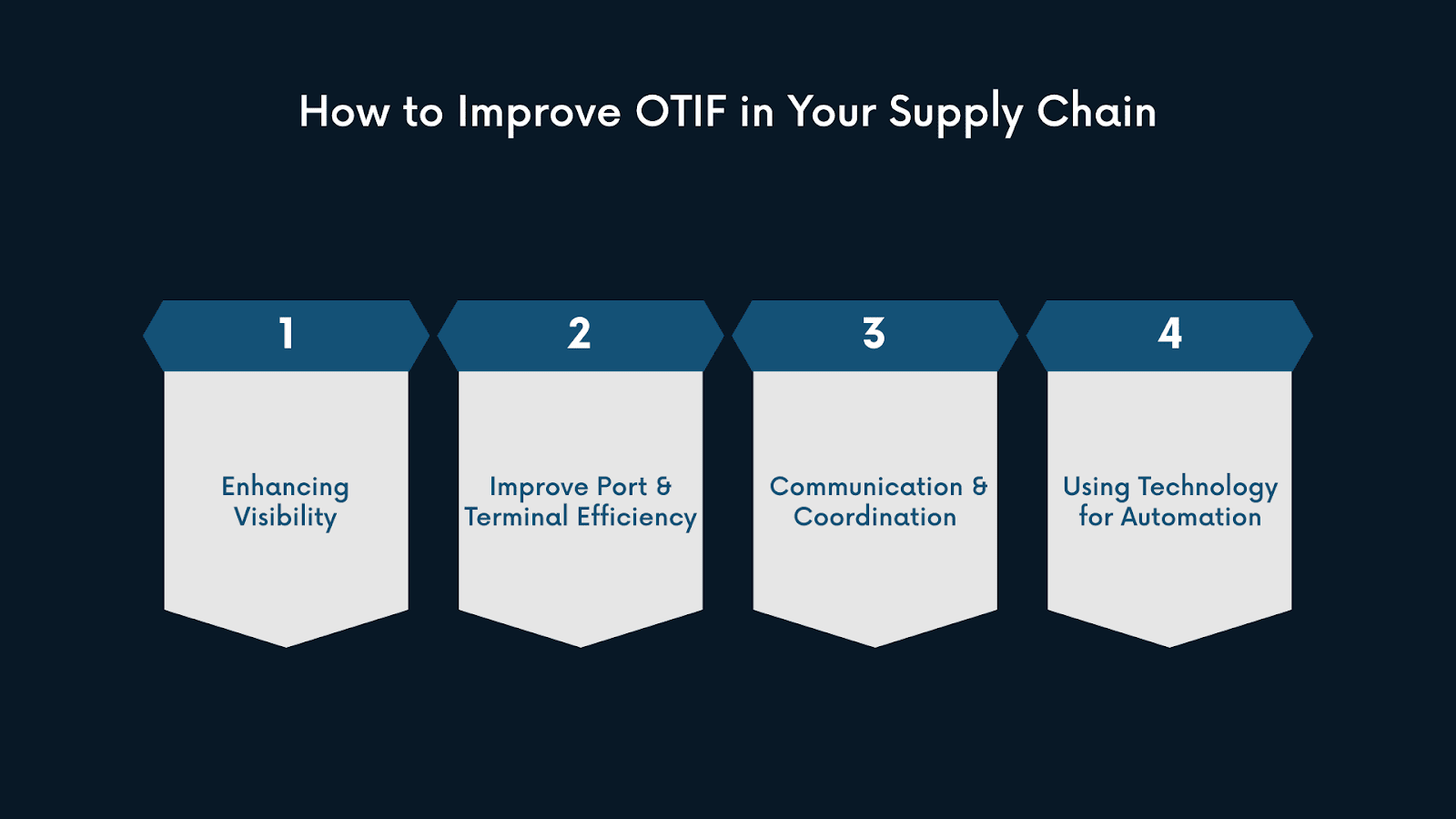
Improving OTIF requires a multifaceted approach addressing visibility, coordination, and operational efficiency across the supply chain.
With real-time data and proactive management, businesses can minimize delays, enhance order accuracy, and consistently meet customer expectations.
1. Enhancing Visibility
Visibility is crucial for improving OTIF, as it helps businesses track shipments at every stage of the journey.
- Track Shipments in Real-Time: Real-time tracking enables businesses to monitor each shipment's progress, ensuring timely deliveries and helping teams react quickly to delays.
- Proactive Management: With visibility tools, logistics managers can identify and resolve issues in the supply chain, whether at port terminals, warehouses, or during transportation, before they impact delivery schedules.
- Use of Live Updates: By integrating Vizion’s real-time data into your systems, businesses can access instant updates on container locations, ETA changes, and critical events.
2. Optimizing Port and Terminal Performance
Port operations' efficiency directly impacts OTIF. Reducing port delays and optimizing the transition from ship to transport can significantly improve delivery timelines.
- Minimize Dwell Time: Shortening vessels' time at the port can reduce overall transit time and prevent backlogs, helping businesses avoid unnecessary delays that impact OTIF.
- Ensure Smooth Transitions: Efficient coordination between terminal operations, drayage providers, and transport companies ensures containers are picked up quickly and move smoothly through the supply chain.
- Vizion’s Contribution: Vizion provides crucial data on port performance, like dwell times, container availability, and berth schedules.
With this visibility, businesses can make real-time adjustments, reduce delays at port terminals, and improve OTIF performance.
3. Effective Communication and Coordination
Strong communication between all parties involved in the supply chain is essential to meeting OTIF goals.
- Collaborate Across Teams: Effective coordination, from freight forwarders to trucking companies, ensures everyone is aligned on delivery schedules and expectations.
- Immediate Issue Resolution: Vizion’s real-time tracking allows businesses to receive immediate notifications about delays, allowing teams to address any issues quickly.
4. Using Technology for Automation
Automating status checks, updates, and reporting helps streamline OTIF tracking and response times.
- Automate Monitoring: Automating monitoring of delivery status, inventory levels, and shipment progress can reduce human error and ensure more accurate OTIF reporting.
With Vizion, businesses can integrate OTIF-related data directly into their existing TMS or ERP systems. This integration simplifies data flow, automates reporting, and helps logistics teams track OTIF metrics across the supply chain in real time, driving continuous improvement.
Common Challenges in Achieving OTIF and How Vizion Solves Them
Achieving OTIF (On-Time, In-Full) performance involves overcoming various obstacles in the supply chain. Addressing these challenges is crucial to maintaining high customer satisfaction and operational efficiency.
1. Port Congestion and Delays
Congestion at busy terminals can delay vessels, impacting the overall delivery schedule.
- Impact on OTIF: When ports are congested, vessels may face delays in docking, unloading, and departure, directly affecting the timeliness of deliveries.
- How Vizion Helps: Vizion’s tracking allows businesses to monitor vessel arrivals and departures at key terminals, providing early visibility into congestion.
By receiving timely updates on port congestion and berth availability, logistics teams can adjust schedules, streamline communication, and reduce delays.
2. Documentation Delays
Inaccurate or incomplete documentation can cause customs delays or hold-ups at the port.
- Impact on OTIF: Delays caused by missing or incorrect documentation can prevent timely clearance and lead to late or partial deliveries.
- How Vizion Helps: Vizion delivers real-time updates on customs clearance events and provides milestone tracking for container and vessel movements.
Automating these updates alerts businesses when documentation issues arise, allowing them to resolve them quickly and maintain OTIF performance.
3. Operational Delays at Terminals
Inefficiencies in port operations, like slow unloading or inadequate equipment availability, can slow the flow of goods and increase berth times.
- Impact on OTIF: Operational delays result in longer docking times, pushing back deliveries and impacting OTIFs' on-time and in-full components.
- How Vizion Helps: Vizion’s port performance data enables businesses to track terminal efficiency, including dwell times and the status of available equipment.
By identifying real-time slowdowns, teams can respond proactively, minimizing delays and improving OTIF scores.
With real-time visibility and actionable insights, businesses can overcome common OTIF challenges, ensuring smoother operations and more reliable delivery performance.
Conclusion
OTIF is crucial for logistics and supply chain professionals to ensure timely and complete deliveries, directly impacting customer satisfaction and efficiency. For roles like Logistics Managers, Supply Chain Managers, and Operations Directors, optimizing OTIF is key to staying competitive and meeting business goals.
With Vizion's real-time container tracking and port performance data, businesses gain enhanced visibility across the supply chain, enabling proactive management and improving OTIF performance.
Book a demo with Vizion:
- Real-Time Container Tracking: Gain access to the most complete, standardized, and detailed container tracking events via API or user interface with real-time container data.
- TradeView: Monitor the live flow of any company's shipments 30 to 90 days before arrival at the destination and analyze trends across 10 years of historical supplier, product, and logistics movement data. With 900 million shipment records, 140+ attributes per shipment, coverage spanning 190 countries, and comprehensive HS code data, TradeView empowers data-driven decisions that optimize global trade management.
- Logistics Performance Hub: Access a comprehensive suite of global logistics datasets, including Port Performance, Port Activity, and Port Pairs, to analyze shipping trends, port throughput, container dwell times, and real-time port activity, enabling smarter decision making about containerized freight movements.
%20-%202026-09-17T163139.307.png)
%20-%202026-08-26T095403.692.png)
%20-%202026-08-24T110906.499.png)


