


Container prices in 2025 are more than just numbers on a freight invoice; they're a make-or-break factor for margin, cash flow, and delivery reliability. From unexpected surcharges to demurrage penalties and port delays, cost volatility now ripples through every corner of logistics operations.
And the fluctuations aren’t slowing down.
As of April 24, 2025, Drewry's World Container Index reported a 2% drop, landing at $2,157 per 40-foot container.
Similarly, the Freightos Baltic Index (FBX) fell 24% month-over-month in March 2025, slipping below its 2024 floor at $2,094 per FEU.
These shifts reflect a broader instability caused by oversupplied vessels, weak global demand, and ongoing disruptions in key shipping corridors.
But while container price forecasts help you see what’s coming, they don’t help you stop what’s already happening.
The Limitations of Freight Rate Forecasts
While freight rate indices like the Freightos Baltic Index (FBX) and Drewry's World Container Index provide valuable insights into market trends, they primarily offer a retrospective view.
These indices reflect historical data, capturing rate fluctuations that have already occurred. However, relying solely on these forecasts can be insufficient for proactive decision-making.
Shippers face challenges that require immediate responses, such as unexpected port congestion, sudden delays, or last-minute changes in shipment schedules. In such scenarios, real-time visibility data becomes indispensable. It enables stakeholders to:
- Respond promptly to disruptions: Immediate access to shipment status enables faster decision-making.
- Optimize logistics operations: Use live data to reduce idle time and improve resource planning.
- Enhance customer satisfaction: Share accurate delivery timelines and build trust.
How Real-Time Visibility Helps Minimize Costs During Container Price Volatility
While freight rate forecasts provide a macro-level view of market trends, they often fall short in helping to manage the immediate operational challenges that arise from price volatility.
Real-time visibility into container movements offers actionable insights that can significantly mitigate these challenges.
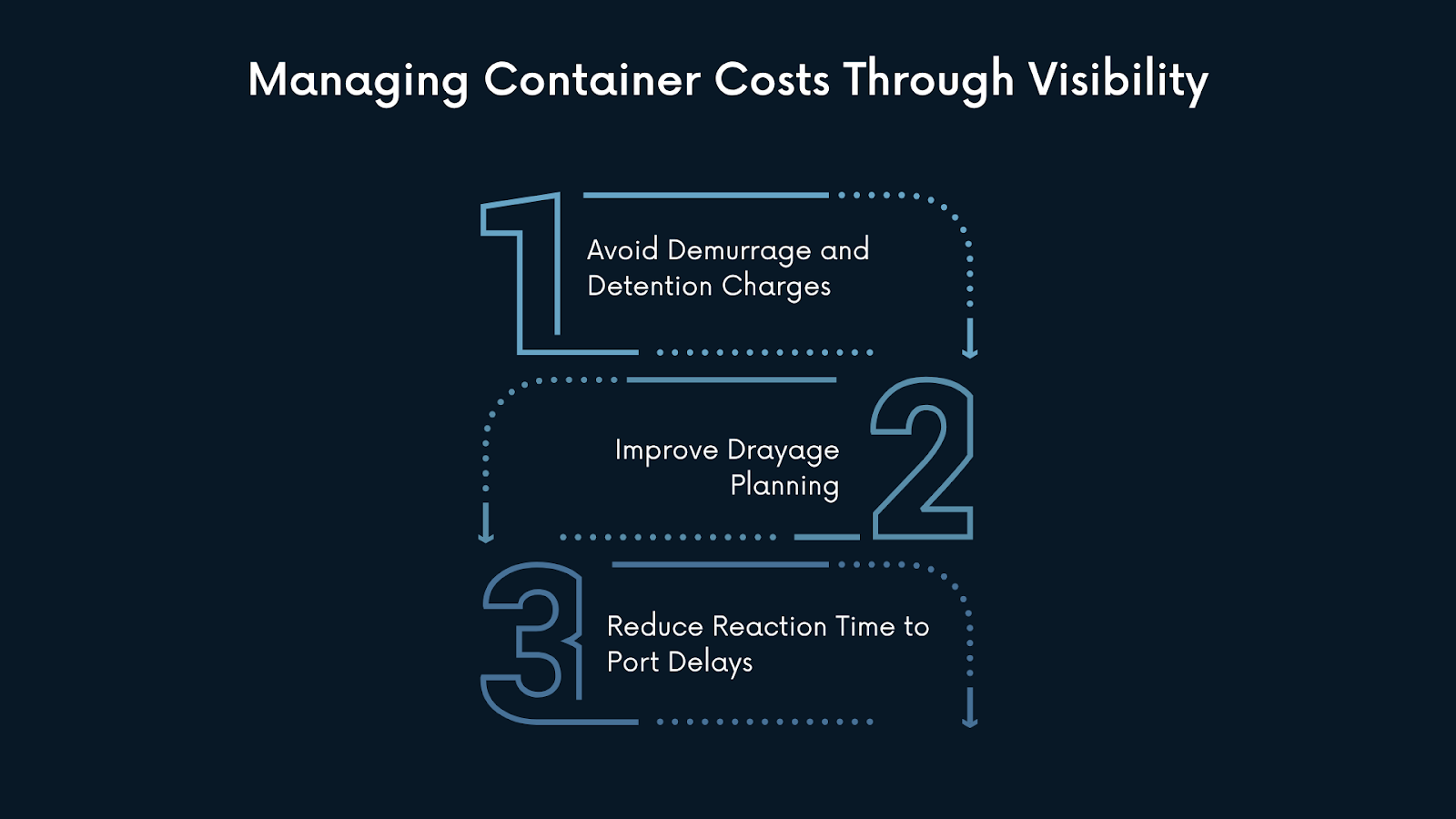
- Avoid Demurrage and Detention Charges
Demurrage and detention charges can accumulate rapidly when containers are delayed at ports or terminals. Real-time tracking enables:
- Proactive Planning: By receiving timely alerts on container arrivals and departures, logistics teams can schedule pickups and returns more efficiently, reducing the likelihood of incurring additional fees.
- Accurate Billing: Access to precise timestamps allows for the verification of carrier invoices, ensuring that charges for detention and demurrage are justified.
Vizion offers features like the "Last Free Date" event, providing alerts before demurrage charges commence, allowing for timely interventions.
Also read: Defining Demurrage and Detention: Key Differences
- Improve Drayage Planning
Efficient drayage operations are crucial for minimizing costs and maintaining schedules. Real-time visibility supports:
- Optimized Scheduling: Knowing the exact location and status of containers allows for better coordination of truck pickups, reducing idle time and improving asset utilization.
- Enhanced Communication: Immediate updates facilitate better communication between shippers, carriers, and customers.
Vizion provides real-time updates on container locations and ETAs, integrating data from terrestrial and satellite AIS, port, and terminal geo-fencing, ensuring accurate and timely information.
- Reduce Reaction Time to Port Delays or Transshipments
Unexpected delays due to port congestion or transshipment issues can disrupt supply chains. Real-time data helps in:
- Quick Decision-Making: Immediate awareness of delays enables logistics teams to reroute shipments or adjust schedules promptly.
- Risk Mitigation: Early detection of potential disruptions allows for contingency planning, reducing the risk of missed deadlines and associated costs.
Vizion aggregates data from various sources, including carrier APIs, terminals, ports, AIS, and third-party sources, providing comprehensive visibility into shipment movements.
Conclusion
In 2025, the key to protecting margins lies in fast decisions, not forecasts. From oversupplied vessels to global trade disruptions, price swings are hitting shippers hard. That’s where operational visibility becomes more than a tool, it's your insurance policy.
By tapping into real-time container tracking, enriched milestone data, and actionable alerts, logistics teams can:
- React faster to disruptions
- Avoid unnecessary fees before they occur
- Protect delivery promises with accurate updates
When rates spike, the real cost is in your reaction time, not just the rate itself.
%20-%202026-09-17T163139.307.png)
%20-%202026-08-26T095403.692.png)
%20-%202026-08-24T110906.499.png)


