


Getting your goods across borders is more than just booking a shipment; it’s about clearing customs without a hitch. A single documentation error or missing fee can lead to your container being held in customs, delaying deliveries and increasing costs. In fact, a 1.5 day average delay is due to customs-related issues alone, according to an IMF report.
Whether you’re new to international logistics or a seasoned freight forwarder, understanding customs holds and releases is vital. This guide breaks down what it means when your shipment is held at customs and why such delays occur. It also explains how to resolve them efficiently using real-time container tracking solutions like Vizion, which help reduce blind spots in your supply chain.
What Does Customs Hold/Customs Release Mean?
If you’re managing international shipments, seeing a status like “held in customs” can be frustrating and confusing. But what exactly does it mean?
A customs hold occurs when authorities temporarily detain your shipment at the border for inspection or verification of paperwork. This isn’t always a sign of wrongdoing; it could be as simple as a random check or a missing invoice. However, until the issue is resolved, your goods are stuck, potentially causing delivery delays and extra storage costs.
On the other hand, a customs release indicates that your shipment has cleared inspection, all documentation has been verified, and any applicable duties or taxes have been paid. In short, it’s ready to move forward.
Understanding the difference between a customs hold and a customs release helps importers, exporters, and freight forwarders avoid surprises. With the proper preparation and real-time visibility solutions like Vizion, you can prevent most of these delays and keep your cargo flowing smoothly.
How Does the Customs Clearance Process Work?
Customs clearance is a critical step in international shipping that confirms goods meet the legal and regulatory standards of the destination country. The process typically includes:
- Document Submission: The importer, exporter, or customs broker submits the required documents, including the commercial invoice, packing list, and certificate of origin, to customs authorities for review.
- Inspection of Goods: Customs officers may inspect the shipment to verify that it matches the declared items and complies with applicable laws and regulations.
- Payment of Duties and Taxes: All import duties, taxes, and additional charges must be paid by the responsible party before the shipment's release.
- Release and Delivery: Once all paperwork is accepted, inspections (if any) are completed, and fees are paid, the shipment is cleared to proceed to its final destination.
Why Your Shipment Might Be Held in Customs: 7 Common Reasons
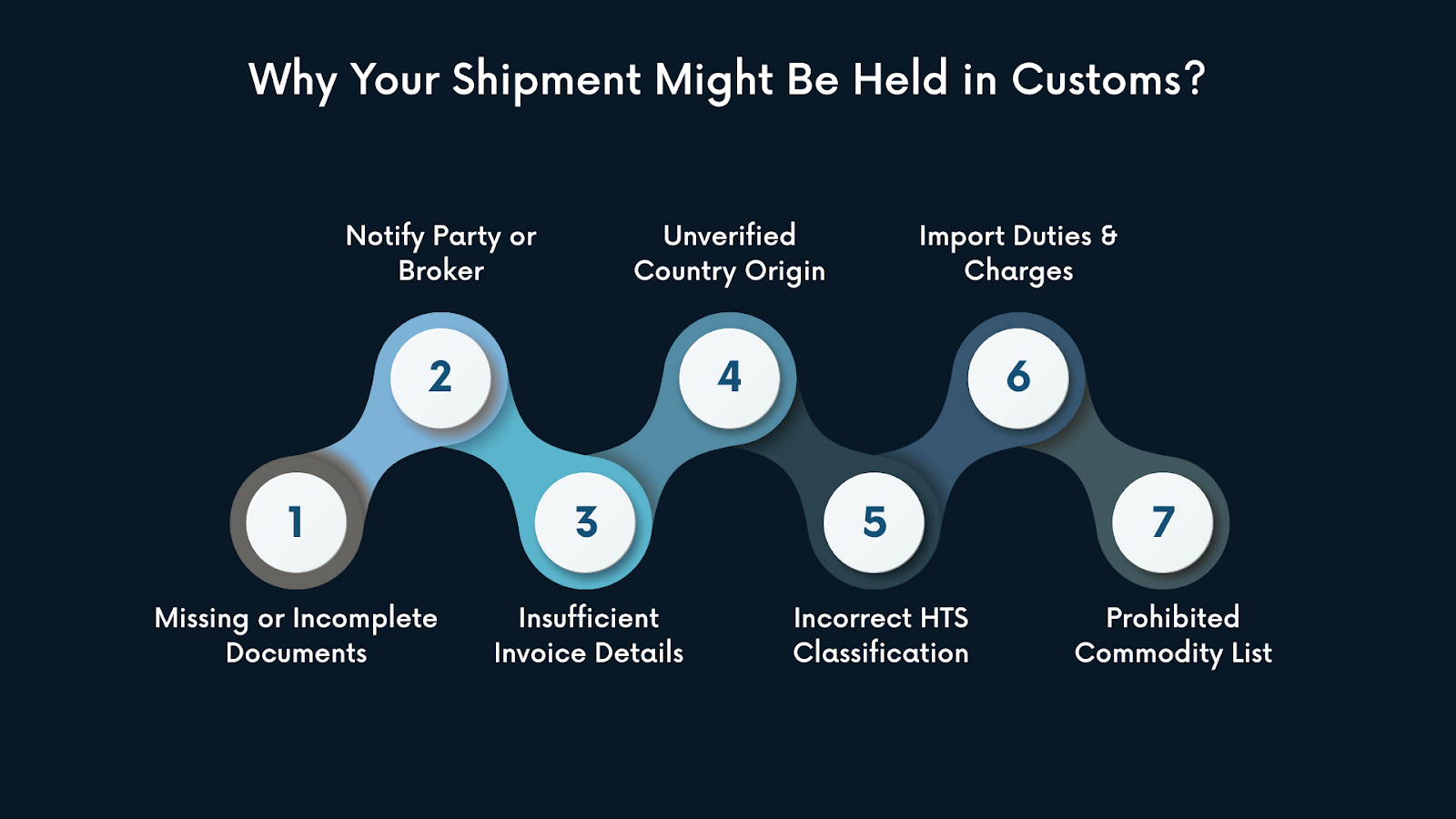
Few phrases can cause more anxiety in international logistics than “held in customs.” Delays at this stage disrupt delivery timelines, increase demurrage costs, and complicate supply chain operations. According to the International Chamber of Commerce (ICC), customs delays are attributed to errors in the documentation process. The good news? Many of these delays are preventable.
Here are seven frequent causes of customs holds you must know:
1. Incomplete or Missing Commercial Documents
Customs clearance hinges on accurate paperwork. Key documents include:
- Commercial Invoice: Details of the goods, buyer/seller, and transaction value.
- Bill of Lading: Confirms ownership of freight and transport terms.
- Packing List: Specifies quantities, weights, and dimensions.
- Arrival Notice: Alerts the consignee of the cargo’s availability.
Additional documentation, such as TSCA declarations or certificates from agencies like the FDA or EPA, may also be required, depending on the goods.
2. Missing Notify Party or Customs Broker
If the customs broker or notify party isn’t listed correctly on the Bill of Lading, the carrier won’t know who to contact for clearance. The result? Your container sits idle while storage fees rack up and paperwork catches up.
3. Inadequate Commercial Invoice Information
For U.S. Customs to release goods, the invoice must list:
- Product description, value, and quantity
- Buyer and seller details
- Country of origin and destination
- HS/HTS classification codes
- Currency used
- Missing or unclear entries can result in rejection or a hold at the port.
4. Incorrect or Unverified Country of Origin
One of the most misunderstood elements in customs documentation is the concept of country of origin. It must reflect where a product underwent a substantial transformation, not simply where it was packed or shipped from. Incorrect labeling could violate trade agreements and result in delayed release.
5. Missing or Incorrect HTS Classification
The Harmonized Tariff Schedule (HTS) code determines your item’s import duty and applicable regulations. Without it, or if it’s incorrect, customs can’t calculate fees or assess compliance with agency requirements (such as FDA, FCC, or USDA).
6. Outstanding Duties and Import Charges
One frequent cause for a shipment being detained by customs is the presence of unpaid import duties or taxes. Most jurisdictions impose tariffs on goods exceeding specific value thresholds. These charges must be settled before the cargo can be released. To avoid such delays, shippers can opt for Delivered Duty Paid (DDP) terms, which make sure that all applicable fees are prepaid at the origin.
For high-value commercial consignments, importers often utilize bonded warehouse facilities where goods can be stored without immediate duty payment until the importer is ready to clear them. This strategy optimizes cash flow while complying with customs requirements.
7. Restricted or Prohibited Commodities
Customs delays can also arise when a shipment includes banned, regulated, or hazardous materials. These may range from controlled substances and flammable items (e.g., fireworks) to goods derived from endangered species, counterfeit currency, and restricted personal items such as vape devices or narcotics.
Additionally, items like alcohol, tobacco, CBD/hemp products, live ammunition, and perishable goods often require special documentation or are outright restricted in many regions. Shippers must verify product eligibility and adhere to all import/export compliance regulations to prevent customs seizures or legal penalties.
Pro Tip: Delays are often rooted in avoidable paperwork gaps. Implementing digital freight visibility solutions, such as Vizion, can help proactively identify documentation issues and optimize customs interactions.
Understanding why your shipment is held is only half the battle, and knowing what to do next is what keeps your supply chain moving. Once a hold is triggered, time is of the essence. Let’s walk through the key steps to resolve a customs hold quickly and efficiently.
7 Steps to Resolve a Customs Hold Quickly (with Vizion)
When a shipment gets stuck at customs, quick action and the right tools can help you avoid lengthy delays and additional costs. Here’s how to tackle a customs hold and how Vizion empowers each step with real-time visibility and data intelligence.
1. Contact Your Freight Forwarder or 3PL Provider
Action: Reach out to your logistics partner immediately to determine the cause of the delay.
How Vizion Helps: Vizion delivers real-time container milestones, including customs hold alerts, so you’re notified the moment an issue arises. It gives you a head start when coordinating with your 3PL or freight forwarder.
2. Verify Documentation
Action: Confirm that all required documents, including the commercial invoice, packing list, and bill of lading, are accurate and complete.
How Vizion Helps: Vizion integrates effortlessly with documentation platforms and TMS solutions to cross-reference shipment data with container events. If the paperwork doesn’t align with expected movements (e.g., a delay at port with no release event), it’s a red flag to review your documents.
3. Engage a Licensed Customs Broker
Action: Consult a broker to file corrections or facilitate communication with customs.
How Vizion Helps: Brokers can use Vizion’s automated container tracking API to monitor delays across all shipments. This visibility allows them to prioritize and address customs issues proactively on your behalf.
4. Settle Outstanding Duties and Taxes
Action: Verify and pay any outstanding import duties, VAT, or other customs fees that may be hindering clearance.
How Vizion Helps: While Vizion doesn’t handle payment directly, its customs event tracking can help identify delays related to payment holds or discrepancies, prompting faster resolution through your broker or shipper.
5. Monitor Shipment Status
Action: Monitor customs updates, release confirmations, and new hold statuses closely.
How Vizion Helps: Vizion provides real-time tracking, including when shipments enter customs, are released, or are flagged for further inspection. You can receive updates via webhook, email, or dashboard, keeping all stakeholders informed in real-time.
6. Prepare for Potential Inspections
Action: If your goods are subject to regulatory review, have safety certificates and compliance documents ready.
How Vizion Helps: With customs inspection milestones flagged, Vizion gives your team lead time to retrieve and submit supporting documents, often before customs makes a formal request, speeding up clearance.
7. Exercise Patience (When Necessary)
Action: In cases of random checks or postal delays, wait while continuing to track the package.
How Vizion Helps: Vizion eliminates the uncertainty of “silent” delays by offering consistent milestone updates, even when shipments are stuck in limbo. You’ll know exactly where your cargo is, even if it’s just sitting at a port or warehouse.
By integrating Vizion’s API into your TMS or logistics dashboard, you can automate customs visibility, optimize communication with carriers and brokers, and prevent minor paperwork issues from turning into significant delays. Talk to an expert now!
Timelines for Customs Clearance
Customs clearance typically takes 24 to 48 hours, but timelines vary depending on the shipment type, the accuracy of documentation, and inspection requirements.
To stay on track, focus on three key phases:
- Pre-arrival processing: Submitting documents early enables customs to begin assessment before arrival, saving critical time.
- Inspections: If flagged, physical or X-ray inspections can add 1–3 business days, depending on port congestion.
- Post-clearance coordination: Delays in broker communication or transport scheduling may increase dwell time and incur extra fees.
While Vizion’s real-time tracking makes sure of complete transparency throughout the clearance process, your job isn’t done once customs releases the container. The next critical phase involves managing post-clearance logistics to make sure of timely delivery and avoid demurrage and detention fees.
Dealing with Post-Clearance Logistics
Once customs clearance is granted, the focus shifts to executing downstream logistics efficiently. However, this phase presents its own set of operational challenges.
1. Receiving Notifications After Customs Clearance
The moment a container is released, timely notification is critical to initiate the next steps.
- Challenge: Delays in updates from carriers or brokers can lead to late pickups, increased dwell times, and additional fees.
- How Vizion Helps: Vizion delivers real-time milestone alerts the moment a container clears customs. This proactive visibility allows you to coordinate transport without delay, avoiding detention or demurrage charges.
2. Arranging Transportation to Final Destination
After clearance, cargo must be quickly moved from the terminal to its final delivery point.
- Challenge: Misalignment between clearance time and truck availability can lead to congestion and lost productivity.
- How Vizion Helps: With continuous container status tracking, Vizion allows you to sync transportation schedules with actual clearance times. Thus making sure that dispatch is smoother and fewer missed handoffs.
3. Managing Additional Inspections or Free Zone Transfers
In some cases, cleared containers may undergo further scrutiny or be transferred to customs-free zones for value-added processing.
- Challenge: Lack of transparency into such movements can create uncertainty, especially when dealing with bonded facilities or special economic zones.
- How Vizion Helps: Vizion provides extended tracking beyond clearance, including visibility into in-terminal movements, allowing for better coordination if further inspections or free zone transitions are involved.
While managing post-clearance logistics is crucial for timely delivery, preventing delays at the source is even more impactful. By addressing potential compliance gaps before your shipment reaches the border, you can reduce the risk of costly holds.
Preventive Measures to Avoid Customs Holds
Delays at customs can disrupt your entire supply chain. Proactive compliance and documentation strategies are essential to prevent such setbacks.
1. Submitting Complete and Accurate Customs Declarations
Incomplete or incorrect information in the Bill of Lading, commercial invoice, or HS codes can trigger holds.
- How Vizion Helps: With integration into your data systems, Vizion highlights document inconsistencies early by comparing submitted milestones and expected documentation status, helping you catch errors before submission.
2. Staying Compliant with Import Regulations
Regulations vary by destination country and commodity. Missing updates on restricted goods or labeling requirements can halt clearance.
- How Vizion Helps: Vizion’s dashboard can be configured to flag compliance-related exceptions in real-time, allowing your team to adjust documentation or procedures before the container reaches customs.
3. Using a Customs Broker for Complex Shipments
Handling multiple product lines, varying origins, or high-risk goods increases the complexity of compliance.
- How Vizion Helps: By integrating with broker workflows, Vizion makes sure that both parties, importer and broker, are aligned on container status, key milestones, and exception events. Thus minimizing communication gaps, accelerating resolution timelines, and improving ETA accuracy.
Conclusion
Being held in customs can disrupt timelines, inflate costs, and create operational bottlenecks, especially when visibility is limited and communication gaps exist. Whether your container is under review or has just cleared customs, having accurate, real-time insights can make all the difference.
Here’s how Vizion helps:
- Real-Time Container Tracking from origin to final delivery
- Automated Milestone Updates, including customs hold and release statuses
- Effortless integration with your TMS, ERP, or visibility platform
- Actionable Alerts to preempt delays and optimize decision-making
By bridging data gaps and enabling proactive logistics management, Vizion empowers you to handle customs events with clarity and confidence.Talk to us today!
FAQ
Q1. Why is my shipment held in customs?
A1. Shipments are often held in customs due to missing paperwork, unpaid duties, security checks, or discrepancies in declared value or contents.
Q2. How long can a container be held in customs?
A2. A container held in customs can be delayed for a few days to several weeks, depending on the issue’s complexity and how quickly it’s resolved.
Q3. What should I do if my cargo is held in customs?
A3. Check with your freight forwarder or customs broker immediately. Provide any missing documents and pay pending duties to avoid further delays.
Q4. Can customs release a held container without inspection?
A4. Yes, if the issue is administrative, like a document mismatch, then customs may release the container without physical inspection after clarification.
Q5. How do I know if my container has cleared customs?
A5. You’ll receive an official release notice from your broker or see a “customs release” status in your container tracking system, like Vizion.
Q6. Will I be charged if my shipment is held in customs?
A6. Yes, charges may include demurrage, storage, and inspection fees, especially if the container remains held in customs for an extended time.
%20-%202026-10-23T152326.396.png)
%20-%202026-10-07T150316.660.png)
%20-%202026-09-17T163139.307.png)


