Back to Resources

Supplier Shifts in Global Trade: China Decline, Vietnam Growth, and Rising Execution Risk

April 20, 2026

In our latest episode of TradeView Live, Vizion's Ben Tracy sat down with Grant Sernick, VP of Sales and Marketing at 3rdwave, to unpack what's actually happening to global trade flows right now — and what it means for importers navigating a world of shifting tariffs, rerouted sourcing, and unpredictable carrier behavior.

The conversation drew on Vizion's TradeView platform, which covers 57% of global ocean container traffic — three times more than the closest competitor — with 270+ data sources and 90-day forward-looking booking forecasts.

"Almost nobody was right about how tariffs were going to impact global trade. The doomsayers were wrong, the dismissers were wrong. What really happened is the underlying dynamics changed — and that's resulting in change."— Grant Sernick, 3rdwave

Global Bookings: Demand Is Holding — And Growing

For the past four years, global ocean container bookings have remained remarkably stable — hovering near 6 million TEU per month in Vizion's platform. But the data from Q1 2026 tells a more dynamic story underneath that headline number.

When January and February are combined (to smooth for Chinese New Year timing), the CTS Global Demand Index showed nearly 10% year-over-year growth for 2026 vs. 2025. March data from TradeView showed an even stronger increase — a signal that importers have been accelerating bookings ahead of anticipated tariff escalation.

US import bookings, however, paint a more complex picture. While global bookings remain elevated, US-specific imports have seen a pronounced pullback relative to 2024 peaks — a reflection of the tariff-driven uncertainty that has caused importers to rethink sourcing origins rather than simply reducing overall volume.

The China Exit: Already Years in the Making

The headline narrative around tariffs often focuses on the shock of Liberation Day (April 2025) or the Trump-era 301 tariffs of 2018. But Grant Sernick offered a crucial clarification: the strategic shift away from China-centric supply chains has been a slow-moving tectonic process, not a sudden rupture.

"Going back to 2018, nobody moved from China back to the United States," Sernick noted. "They moved from China to other places — Taiwan, Cambodia, Vietnam, Pakistan." The result: years of gradual diversification, and then Liberation Day accelerated what was already in motion.

Key Insight from TradeView Data

Chinese export bookings are structurally depressed relative to prior years — and companies like Walmart and Amazon show the numbers to prove it. These aren't short-term fluctuations; they represent years of deliberate supplier network rebalancing now measurable at the booking level.

China Supplier Shifts — Q1 2026 vs. Q1 2025
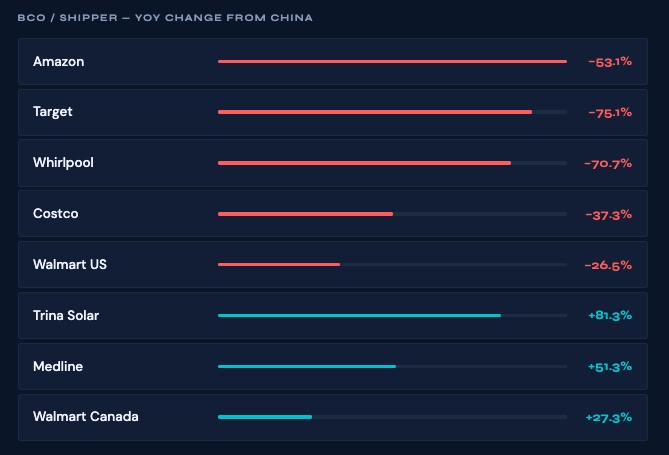
Notably, Walmart Canada's volume from China is up — a reminder that tariff-driven shifts are specific to the US trade relationship, not a global rejection of Chinese manufacturing. The same parent company is pursuing radically different sourcing strategies across borders based on tariff exposure.

Vietnam: The Clearest Beneficiary — For Now

If China is where volume is leaving, Vietnam is where much of it is going. Vietnam export bookings have grown dramatically over the past several years, with the 2025 trend showing a structural step-change over prior years. The Vietnam-to-US corridor in particular was a standout in the TradeView data heading into early 2026, before temporary tariffs created a brief interruption in March.

Vietnam Supplier Shifts — Q1 2026 vs. Q1 2025

The magnitude of these shifts is striking. Companies aren't just testing Vietnam as an alternative — they're making it a primary sourcing origin. The data suggests these changes are structural, not tactical: multi-year supplier relationships, new factory capacity, and favorable tariff treatment relative to China have all reinforced Vietnam's rise.

Carrier Market Share: Who's Winning the Volume War

As sourcing origins shift, so does the competitive landscape among ocean carriers. Vizion's booking data now tracks carrier-level volume across all major operators — revealing meaningful market share movement that doesn't always align with earnings narratives.

Maersk's decline aligns with the company's publicly stated strategy — a pivot away from pure carrier scale toward integrated logistics services. As Grant Sernick noted, Maersk appears comfortable ceding volume to competitors while building out its broader supply chain services business. MSC, by contrast, appears to be competing aggressively on volume, potentially accepting tighter margins to build market share.

Origin Ports Shifting — APAC Rising, EMEA Slowing

The port-level data reinforces the regional story. Asia-Pacific origin ports are growing across the board, led by Shanghai (+15.2%) and Singapore (+18.7% — the strongest growth of any major port). EMEA, meanwhile, is contracting, with Rotterdam down 12.5% as European export demand softens.

On the destination side, Los Angeles remains the dominant US gateway at 2.1M TEU. Long Beach saw a notable 12.3% decline — a possible routing shift as shippers look to diversify port risk and manage congestion.

What This Means for Importers

With all of this volatility — shifting origins, fluctuating carrier market share, tariff policy still in flux — what should importers actually do? Sernick's answer centered not on tactics, but on technology foundation:

Actionable Takeaway

"We are now operating in a world where there is lots of change and lots of variability — and this is not going away anytime soon. The single biggest thing any importer of consequence should be asking today is: do you have the technology underpinnings to understand the changing dynamics of the world? If the answer is no, that's where to start."

The implication is clear: the companies that will navigate the next wave of disruption — whatever form it takes — are those that can detect change in near-real-time, before it shows up in a freight invoice or a missed delivery window. That means visibility into bookings, not just shipments. It means understanding what your competitors are doing with their supplier networks. And it means having 90-day forward indicators, not just backward-looking reports.

The era of set-it-and-forget-it supply chain strategy is over. Supplier shifts are creating new execution risks at every layer — sourcing, routing, carrier selection, port capacity. The companies winning are the ones that can see those shifts before they become crises.

Explore the Data Yourself

TradeView by Vizion gives you booking-level intelligence on 1.5M+ companies, 270+ data sources, and 90-day forward trade forecasts. Request access to TradeView below.

Get the Most Advanced Visibility into the Journey of Your Ocean and Rail Containers

Talk to one of our supply chain experts to get started now.

Talk to an Expert

Thank you for your submission!

A member of the Vizion team will be in touch shortly.
Oops! Something went wrong while submitting the form.

Talk to an Expert

Thank you for your submission!

A member of the Vizion team will be in touch shortly.
Oops! Something went wrong while submitting the form.
close modal icon

Book a Demo

Are you ready to experience the many benefits of container visibility? Schedule a VIZION API demo today.

Thank you for your submission!

A member of the Vizion team will be in touch shortly.
Oops! Something went wrong while submitting the form.
close modal icon

Supplier Shifts in Global Trade: China Decline, Vietnam Growth, and Rising Execution Risk

April 20, 2026

In our latest episode of TradeView Live, Vizion's Ben Tracy sat down with Grant Sernick, VP of Sales and Marketing at 3rdwave, to unpack what's actually happening to global trade flows right now — and what it means for importers navigating a world of shifting tariffs, rerouted sourcing, and unpredictable carrier behavior.

The conversation drew on Vizion's TradeView platform, which covers 57% of global ocean container traffic — three times more than the closest competitor — with 270+ data sources and 90-day forward-looking booking forecasts.

"Almost nobody was right about how tariffs were going to impact global trade. The doomsayers were wrong, the dismissers were wrong. What really happened is the underlying dynamics changed — and that's resulting in change."— Grant Sernick, 3rdwave

Global Bookings: Demand Is Holding — And Growing

For the past four years, global ocean container bookings have remained remarkably stable — hovering near 6 million TEU per month in Vizion's platform. But the data from Q1 2026 tells a more dynamic story underneath that headline number.

When January and February are combined (to smooth for Chinese New Year timing), the CTS Global Demand Index showed nearly 10% year-over-year growth for 2026 vs. 2025. March data from TradeView showed an even stronger increase — a signal that importers have been accelerating bookings ahead of anticipated tariff escalation.

US import bookings, however, paint a more complex picture. While global bookings remain elevated, US-specific imports have seen a pronounced pullback relative to 2024 peaks — a reflection of the tariff-driven uncertainty that has caused importers to rethink sourcing origins rather than simply reducing overall volume.

The China Exit: Already Years in the Making

The headline narrative around tariffs often focuses on the shock of Liberation Day (April 2025) or the Trump-era 301 tariffs of 2018. But Grant Sernick offered a crucial clarification: the strategic shift away from China-centric supply chains has been a slow-moving tectonic process, not a sudden rupture.

"Going back to 2018, nobody moved from China back to the United States," Sernick noted. "They moved from China to other places — Taiwan, Cambodia, Vietnam, Pakistan." The result: years of gradual diversification, and then Liberation Day accelerated what was already in motion.

Key Insight from TradeView Data

Chinese export bookings are structurally depressed relative to prior years — and companies like Walmart and Amazon show the numbers to prove it. These aren't short-term fluctuations; they represent years of deliberate supplier network rebalancing now measurable at the booking level.

China Supplier Shifts — Q1 2026 vs. Q1 2025

Notably, Walmart Canada's volume from China is up — a reminder that tariff-driven shifts are specific to the US trade relationship, not a global rejection of Chinese manufacturing. The same parent company is pursuing radically different sourcing strategies across borders based on tariff exposure.

Vietnam: The Clearest Beneficiary — For Now

If China is where volume is leaving, Vietnam is where much of it is going. Vietnam export bookings have grown dramatically over the past several years, with the 2025 trend showing a structural step-change over prior years. The Vietnam-to-US corridor in particular was a standout in the TradeView data heading into early 2026, before temporary tariffs created a brief interruption in March.

Vietnam Supplier Shifts — Q1 2026 vs. Q1 2025

The magnitude of these shifts is striking. Companies aren't just testing Vietnam as an alternative — they're making it a primary sourcing origin. The data suggests these changes are structural, not tactical: multi-year supplier relationships, new factory capacity, and favorable tariff treatment relative to China have all reinforced Vietnam's rise.

Carrier Market Share: Who's Winning the Volume War

As sourcing origins shift, so does the competitive landscape among ocean carriers. Vizion's booking data now tracks carrier-level volume across all major operators — revealing meaningful market share movement that doesn't always align with earnings narratives.

Maersk's decline aligns with the company's publicly stated strategy — a pivot away from pure carrier scale toward integrated logistics services. As Grant Sernick noted, Maersk appears comfortable ceding volume to competitors while building out its broader supply chain services business. MSC, by contrast, appears to be competing aggressively on volume, potentially accepting tighter margins to build market share.

Origin Ports Shifting — APAC Rising, EMEA Slowing

The port-level data reinforces the regional story. Asia-Pacific origin ports are growing across the board, led by Shanghai (+15.2%) and Singapore (+18.7% — the strongest growth of any major port). EMEA, meanwhile, is contracting, with Rotterdam down 12.5% as European export demand softens.

On the destination side, Los Angeles remains the dominant US gateway at 2.1M TEU. Long Beach saw a notable 12.3% decline — a possible routing shift as shippers look to diversify port risk and manage congestion.

What This Means for Importers

With all of this volatility — shifting origins, fluctuating carrier market share, tariff policy still in flux — what should importers actually do? Sernick's answer centered not on tactics, but on technology foundation:

Actionable Takeaway

"We are now operating in a world where there is lots of change and lots of variability — and this is not going away anytime soon. The single biggest thing any importer of consequence should be asking today is: do you have the technology underpinnings to understand the changing dynamics of the world? If the answer is no, that's where to start."

The implication is clear: the companies that will navigate the next wave of disruption — whatever form it takes — are those that can detect change in near-real-time, before it shows up in a freight invoice or a missed delivery window. That means visibility into bookings, not just shipments. It means understanding what your competitors are doing with their supplier networks. And it means having 90-day forward indicators, not just backward-looking reports.

The era of set-it-and-forget-it supply chain strategy is over. Supplier shifts are creating new execution risks at every layer — sourcing, routing, carrier selection, port capacity. The companies winning are the ones that can see those shifts before they become crises.

Explore the Data Yourself

TradeView by Vizion gives you booking-level intelligence on 1.5M+ companies, 270+ data sources, and 90-day forward trade forecasts. Request access to TradeView below.

Talk to an Expert

Book A Demo

Are you ready to experience the many benefits of container visibility? Schedule a VIZION API demo today.

close icon
Only valid business email addresses.
Please include country code.
Thank you! Your submission has been received!
Oops! Something went wrong while submitting the form.