


.png)
The Strait of Hormuz is one of the most critical maritime chokepoints in global trade. Nearly a fifth of the world’s oil and a significant share of regional container traffic flows through the narrow waterway connecting the Arabian Gulf to the Indian Ocean.
When shipping access through the strait is disrupted, the impact is felt immediately across Gulf supply chains.
New container booking data from Vizion’s TradeView platform shows that both import and export bookings across major Arabian Gulf ports collapsed in early March, signaling a rapid reaction from shippers and carriers as uncertainty around vessel movements through the Strait of Hormuz intensified.
The data spans ten major regional ports including Jebel Ali, Dammam, Umm Qasr, Hamad, Sohar, Khalifa, Shuwaikh, Shuaiba, Sharjah, and Al Jubail.
Export Bookings Collapse as Carriers Pause Gulf Departures
Daily Container Export Bookings from Arabian Gulf Ports
Daily container export bookings from Arabian Gulf ports remained relatively stable through December, January, and February. While day-to-day volumes fluctuate due to operational booking cycles, the underlying trend shows consistent outbound cargo demand from the region.
Export bookings during this period averaged roughly 4,000–5,000 TEU per day across the Gulf.
That pattern changes dramatically in early March.
Export bookings across the region begin to fall sharply, with several days showing near-zero booking activity. The 7-day rolling average declines quickly as exporters appear to delay shipments amid growing uncertainty around shipping routes through the Strait of Hormuz.
Several dynamics may explain this sudden shift:
• Carriers temporarily delaying or adjusting sailings through the region
• Exporters holding cargo until vessel schedules stabilize
• Freight forwarders delaying booking commitments until routing risk becomes clearer
Because container bookings typically occur weeks before cargo departs, this decline provides an early signal that outbound cargo flows from Gulf ports may be disrupted in the near term.
Import Bookings Show the Same Sudden Collapse
Daily Container Import Bookings to Arabian Gulf Ports
The same pattern appears on the import side.
Prior to early March, daily container import bookings into Arabian Gulf ports regularly ranged between 10,000 and 16,000 TEU, with the 7-day rolling average consistently hovering near 10,000–11,000 TEU per day.
This steady inbound flow reflects the Gulf’s role as a major import hub, supporting construction projects, industrial production, and consumer demand across the region.
But once geopolitical tensions escalated, inbound booking activity dropped sharply.
Daily import bookings quickly fell toward zero, mirroring the sudden decline seen in export bookings.
For importers, the hesitation is understandable. If vessels cannot reliably transit through the Strait of Hormuz, cargo risk increases significantly. Many shippers choose to delay bookings until carriers provide clarity on routing, security conditions, and schedule reliability.
Booking Data Reveals How Quickly Supply Chains React
One of the most valuable characteristics of container booking data is how quickly it reflects changes in supply chain behavior.
Traditional shipping indicators — such as port throughput or vessel arrivals — often take weeks to reveal the impact of geopolitical disruptions. By the time those metrics shift, the disruption has already moved through the logistics network.
Container bookings represent future cargo demand.
When exporters and importers stop booking containers, it signals that cargo is not expected to move in the coming weeks. This makes booking data one of the earliest indicators available for understanding how geopolitical events are influencing global shipping activity.
In this case, the near-immediate decline in bookings suggests that market participants rapidly adjusted behavior once uncertainty around the Strait of Hormuz increased.
Jebel Ali Port Dwell Time Climbs Sharply Since February
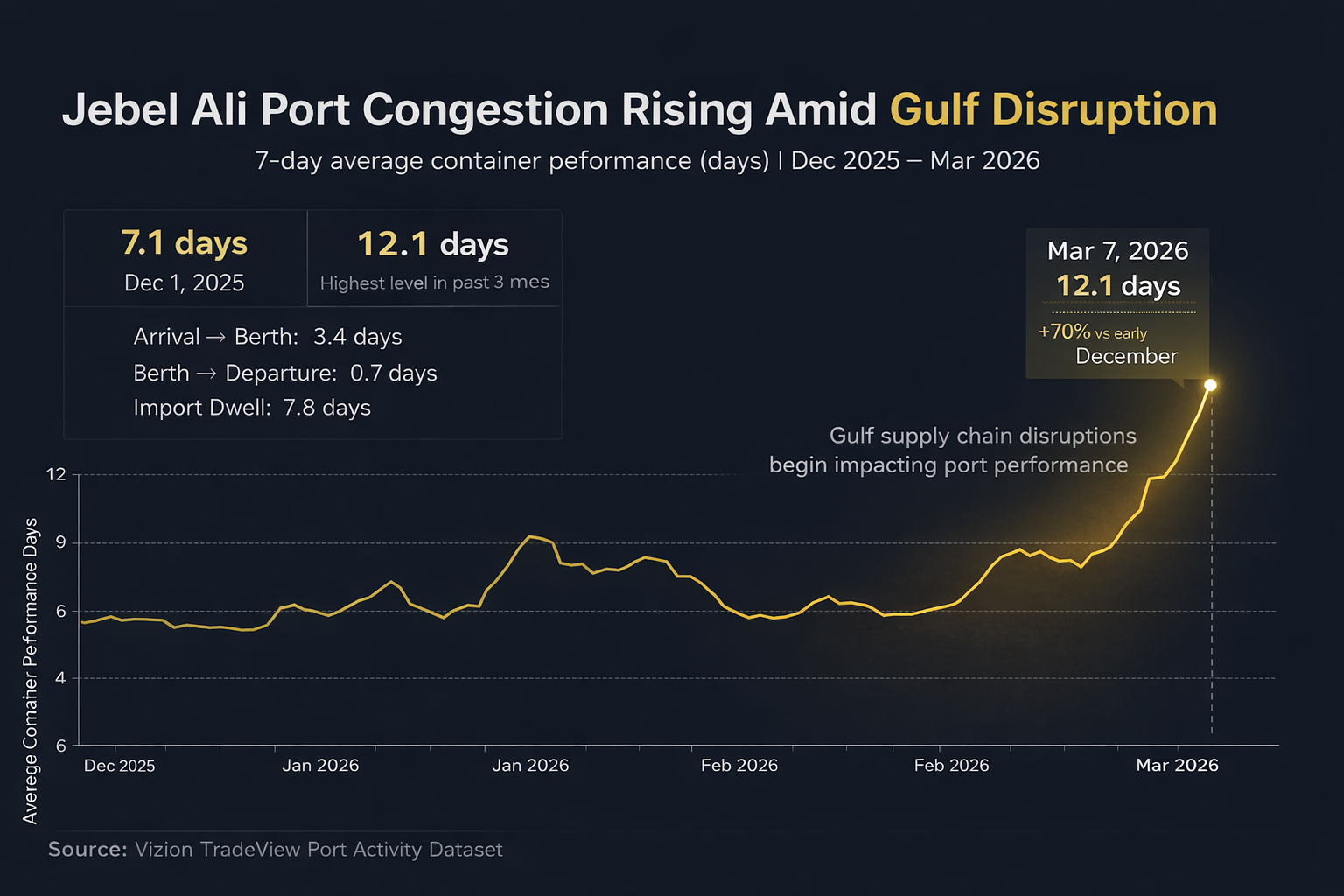
While booking activity is falling, operational data from one of the region’s largest container hubs shows port congestion increasing rapidly.
Container performance at Jebel Ali Port, the Middle East’s largest container terminal, has deteriorated sharply in recent weeks.
The 7-day average container cycle time at the port increased from 7.1 days in early December to 12.1 days by March 7, representing a 70% increase in overall container performance time.
Breaking down the port performance metrics:
• Arrival → Berth: 3.4 days
• Berth → Departure: 0.7 days
• Import Dwell Time: 7.8 days
The rise in dwell time suggests that containers are spending longer inside the terminal, potentially reflecting operational slowdowns, vessel scheduling disruptions, or cargo delays tied to broader regional uncertainty.
As shipping networks adjust to geopolitical disruptions, congestion at major ports like Jebel Ali can quickly amplify supply chain delays.
The Containerized Products Most Exposed to the Strait of Hormuz Disruption
Container export bookings from Arabian Gulf ports are heavily concentrated in a small number of industrial product categories. TradeView booking data from January through mid-March shows that petrochemical materials dominate containerized exports leaving the region.
The largest product categories include:
• Plastics and polymer resins — ~63% of export bookings
• Aluminum and metal products — ~16% of export bookings
• Petroleum byproducts and industrial fuels — ~11% of export bookings
• Paper, recycling materials, and other industrial inputs — ~10% of export bookings
The dominance of petrochemical exports reflects the Gulf’s position as one of the world’s largest producers of plastic feedstocks such as polyethylene and polypropylene.
These materials serve as critical inputs for global manufacturing supply chains, supporting industries such as packaging, automotive production, consumer goods manufacturing, and medical equipment.
Because these products move primarily through containerized supply chains rather than bulk shipping, disruptions affecting Gulf container ports could ripple quickly through global industrial production networks.
Stay Ahead of Global Trade Disruptions
Vizion’s TradeView platform provides real-time visibility into container booking trends, port performance, and emerging shifts in global trade flows.
By monitoring forward-looking indicators such as booking activity and port congestion, supply chain teams can identify disruptions earlier and make more informed routing, procurement, and inventory decisions.
Explore how TradeView helps organizations track global shipping activity and anticipate supply chain disruptions.
%20-%202026-09-17T163139.307.png)
%20-%202026-08-26T095403.692.png)
%20-%202026-08-24T110906.499.png)


