Back to Resources

Vizion SDPI: A 7 to 14 Day Head Start on Ocean Freight Pressure

August 20, 2026

For a year and a half, TradeView has reported what is being booked, where it is going, and how volumes compare to last year. That data answers the "what" question well. It answers the "so what" question less well. A shipper looking at a lane that grew 20% still has to guess whether they will get an allocation next week, and whether the rate quoted today will hold.

The Supply-Demand Pressure Index (SDPI) is built for the second question. It is a daily pressure score for every origin-destination pair in the ocean freight network, benchmarked to a 12-month rolling baseline. For the read below we scored the top 1,000 port pairs by TEU volume, roughly 366,000 booking rows per day, and recalculated daily.

How the index works

Demand is the booking-request volume flowing into a port pair. Supply is a proprietary blend of several inputs: ocean service capacity and vessel assignments, carrier acceptance rates, booking modification rates, and the behavior patterns of different party types across geographies. The score publishes as two reads, a 28-day weighted index and a 7-day spot index. The gap between them tells you which direction a lane is moving.

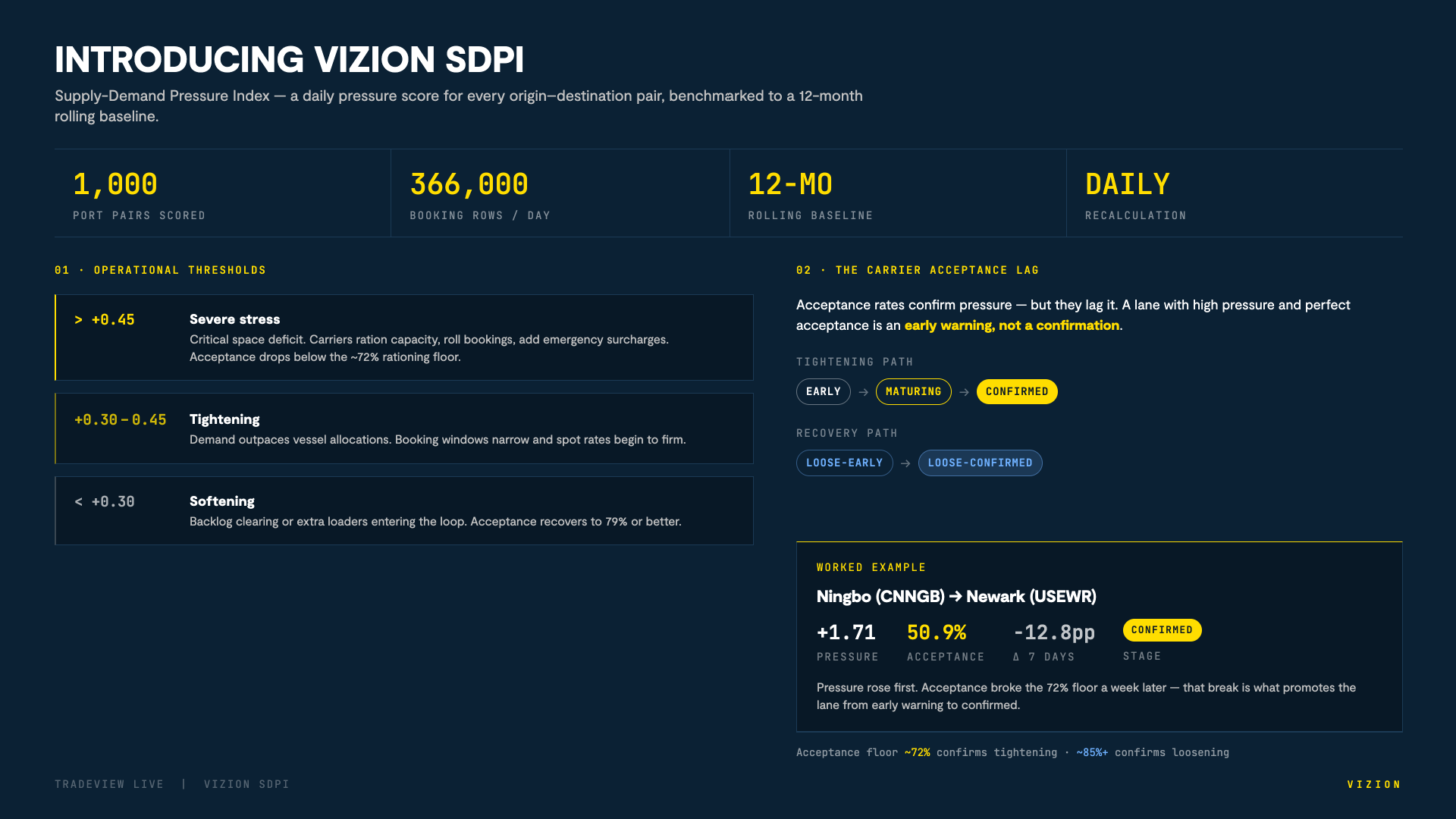
Three operating thresholds: above +0.45 is severe stress, where carriers ration capacity, roll bookings, and add emergency surcharges. +0.30 to +0.45 is tightening, where demand outpaces vessel allocations and spot rates begin to firm. Below +0.30 is softening.

The piece most rate indices do not have is carrier acceptance. Acceptance confirms pressure, but it lags it. A lane with high pressure and perfect acceptance is an early warning. A lane where acceptance has broken below roughly 72% is a confirmed squeeze. That lag is the window, and in our data SDPI has moved 7 to 14 days ahead of the major rate indices. Ningbo to Newark is the worked example: pressure rose first, and acceptance broke the floor a week later, falling 12.8 points to 50.9%.
The first read: easing, with pockets of stress

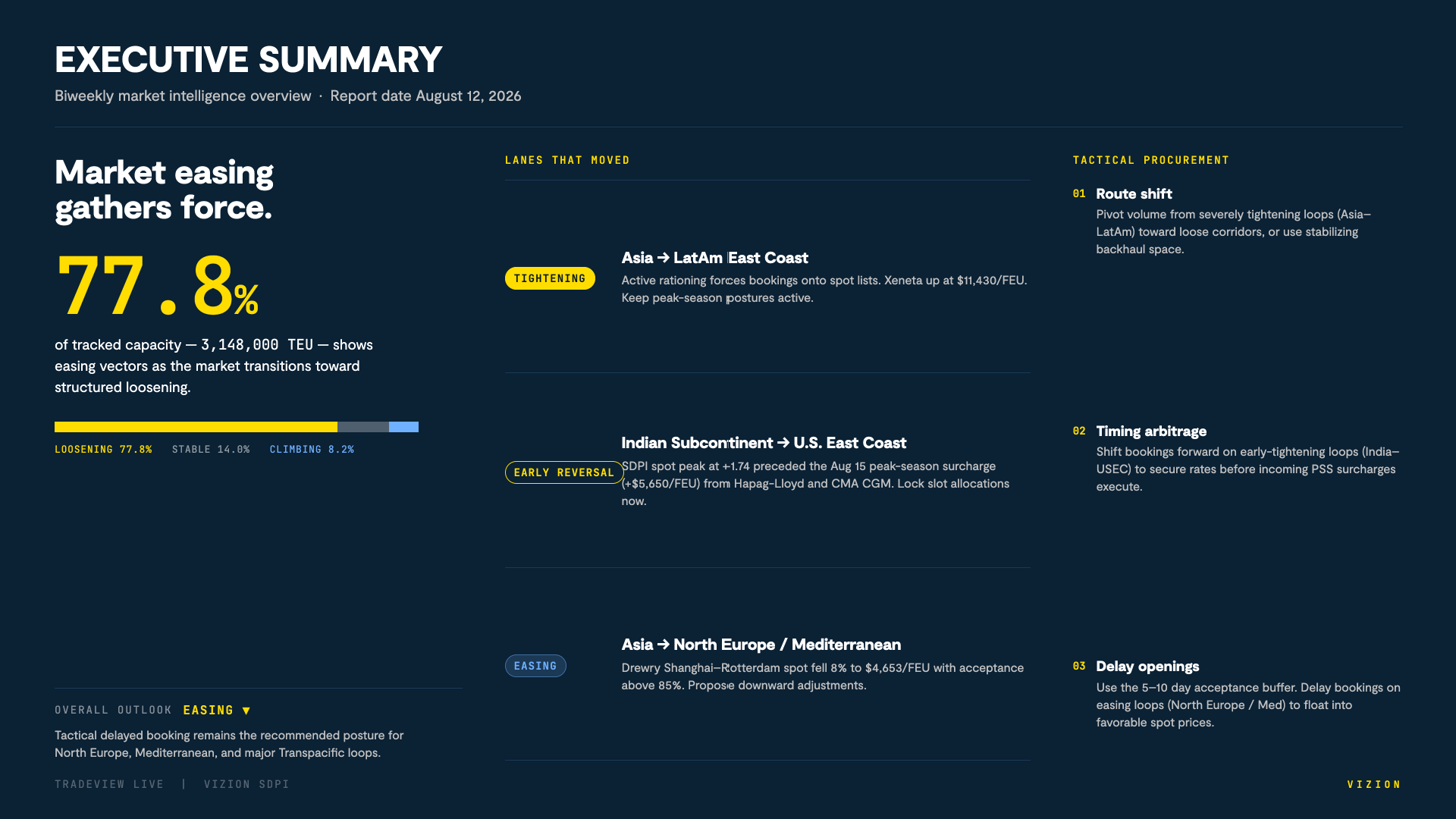
The market is loosening. 77.8% of tracked capacity sits in a loosening vector, 14.0% is stable, and 8.2% is climbing. That loosening share covers 3,148,000 TEU of 28-day booking volume. Rates on the big east-west lanes have flattened or started to fall, and the posture for North Europe, the Mediterranean, and most Transpacific loops is to delay non-critical bookings.

Three lanes moved against that grain.

Asia to Latin America East Coast is confirmed tightening. Carriers are actively rationing space and pushing bookings onto spot lists, with Xeneta reading $11,430/FEU. Reshuffled service capacity and blank sailings have concentrated the pressure here, and the Panama Canal draft restrictions announced this month are a further factor to watch.

Indian Subcontinent to US East Coast is an early reversal. The 7-day spot read peaked at +1.74 against a 28-day weighted read of +0.76, and that spike preceded the August 15 peak-season surcharge of $5,650/FEU from Hapag-Lloyd and CMA CGM. If your allocations on this lane matter, lock slots at today's terms rather than wait for the easing to arrive.

Asia to North Europe and Mediterranean are easing. The Drewry Shanghai to Rotterdam spot fell 8% to $4,653/FEU with acceptance above 85%. This is where the delay posture pays.
Lane by lane

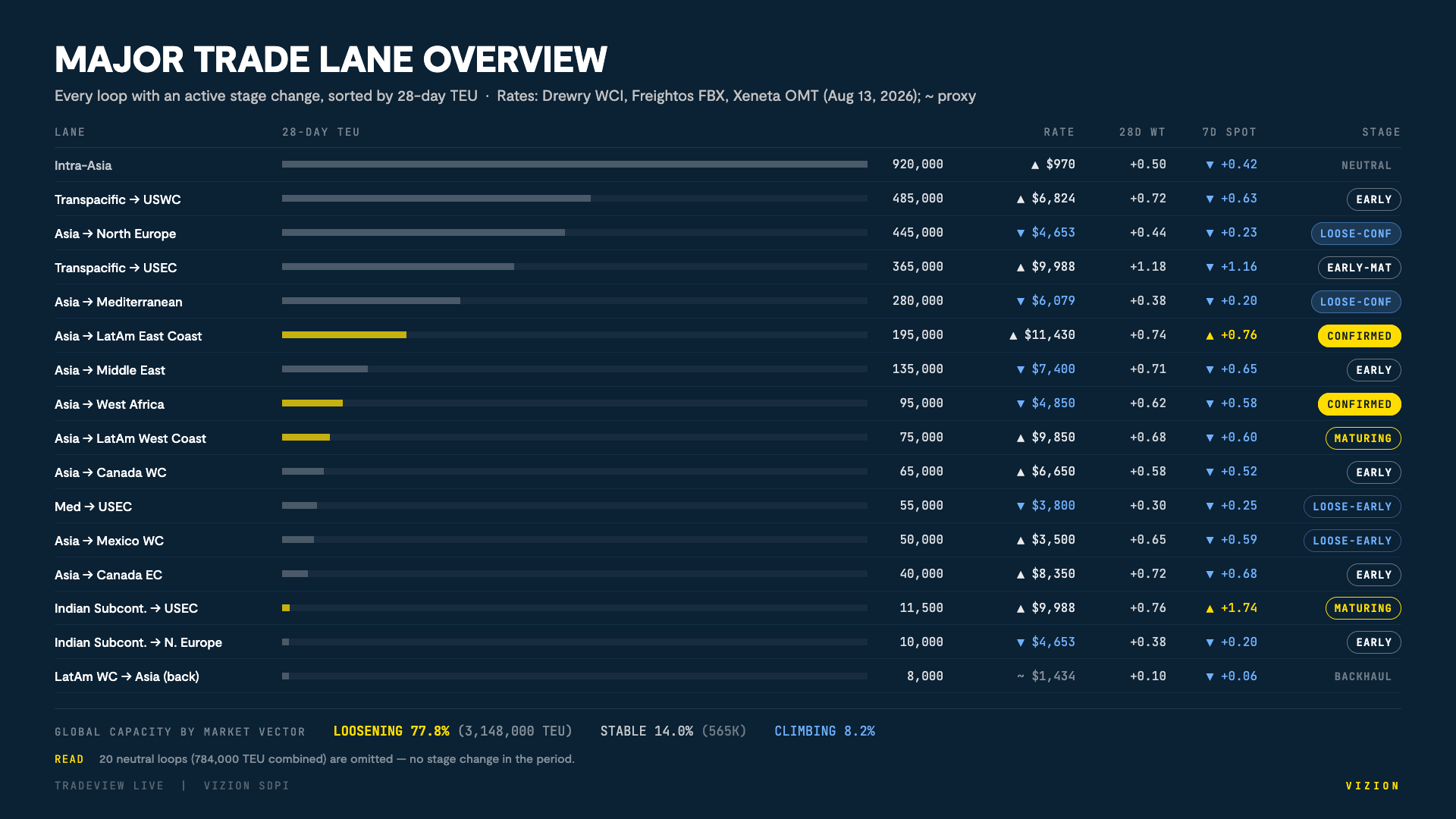
Every major loop with an active stage change, sorted by 28-day booking volume. Read the two right-hand columns together: when the 7-day spot is below the 28-day weighted, pressure is easing.

Transpacific to US East Coast is the largest lane still above the severe-stress line on both reads, +1.18 weighted and +1.16 spot. It is holding at peak rather than falling. Transpacific to US West Coast has started to turn, with spot (+0.63) now below weighted (+0.72). Intra-Asia, the largest lane by volume at 920,000 TEU, is neutral and drifting lower. Asia to West Africa is confirmed tightening and Asia to Latin America West Coast is maturing. Twenty neutral loops covering 784,000 TEU had no stage change and are left off.
Port pairs that moved

Trade lanes are the right unit for a market summary. They are the wrong unit for a booking decision. A shipper moving Qingdao to Buenos Aires does not care that Asia to Latin America is "tightening" in aggregate. They care whether their carrier is accepting bookings this week.

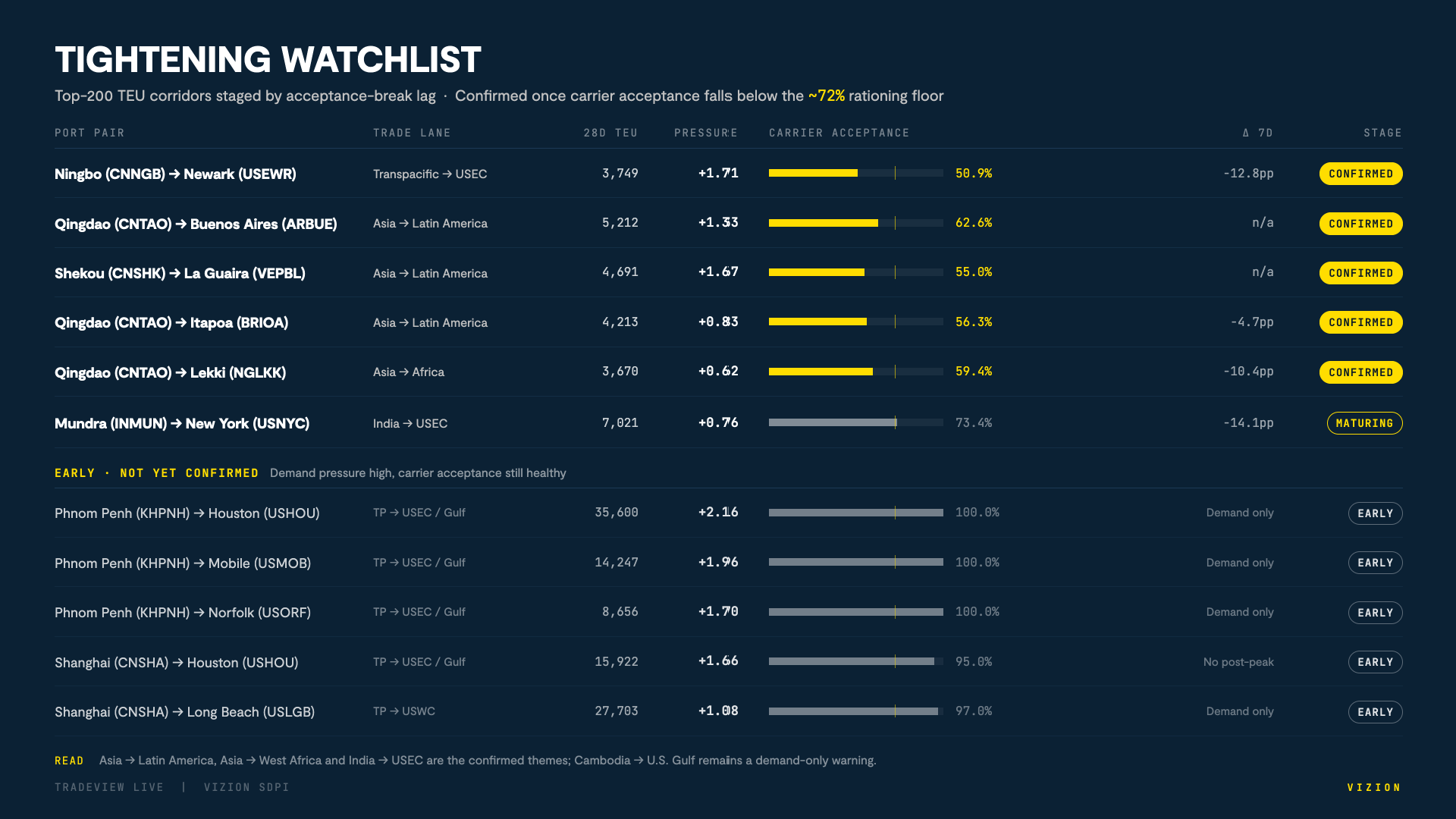
Tightening. Ningbo to Newark, Qingdao to Buenos Aires, Shekou to La Guaira, Qingdao to Itapoa, and Qingdao to Lekki are confirmed: carrier acceptance sits between 50% and 63%, well below the rationing floor. Mundra to New York is maturing, with acceptance at 73.4% and down 14.1 points in the past week. Expect rolled bookings and heightened rates on all six. Below them sit the early warnings: Phnom Penh to Houston, Mobile, and Norfolk, plus Shanghai to Houston and Shanghai to Long Beach, all carrying very high demand pressure while acceptance still runs at 95% to 100%. That combination is the first stage of the tightening path. Cambodia is the one to watch; combined with Vietnam, its export volume to the US now approaches what China sends.
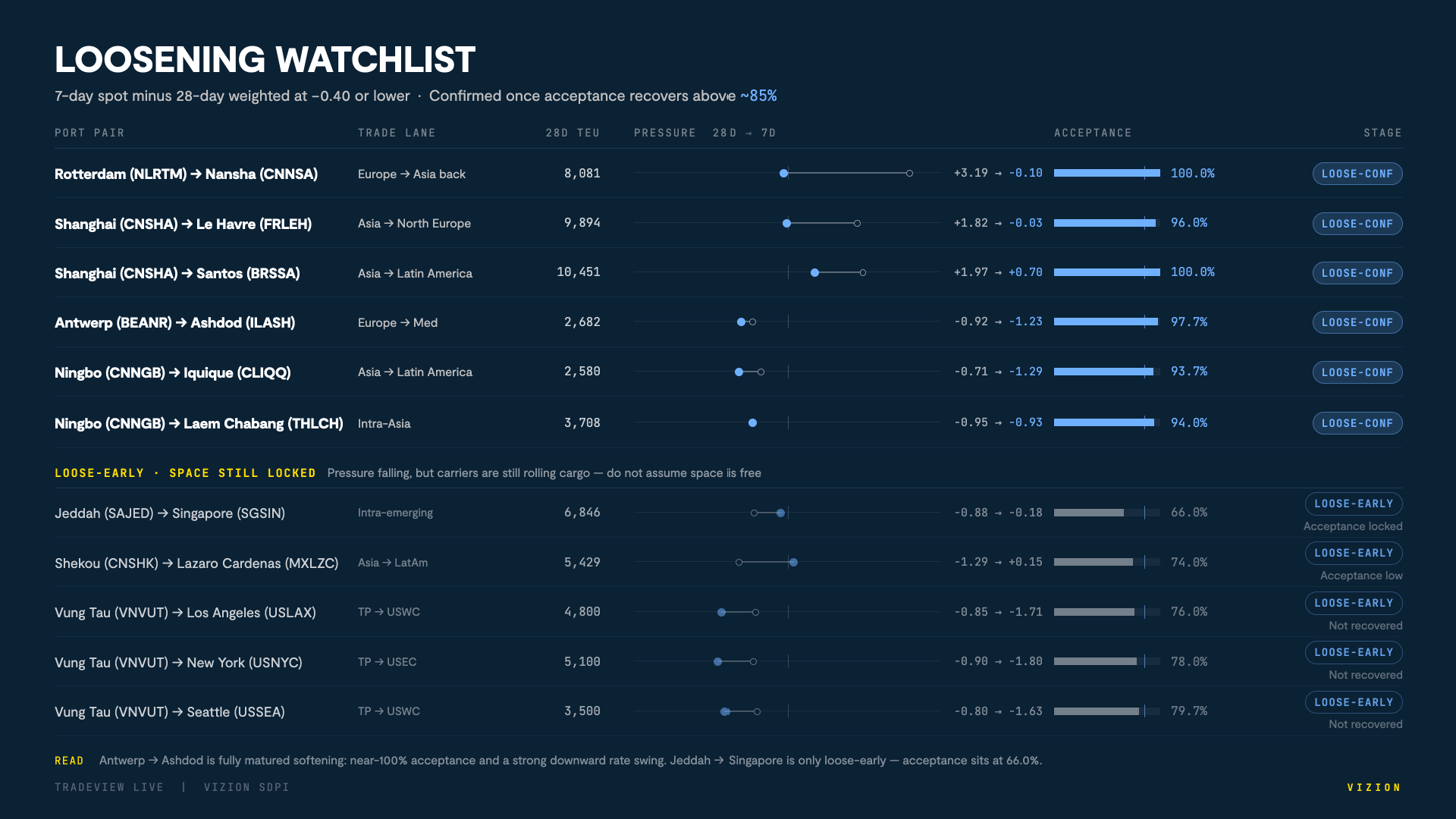
Loosening. Rotterdam to Nansha, Shanghai to Le Havre, Shanghai to Santos, Antwerp to Ashdod, Ningbo to Iquique, and Ningbo to Laem Chabang are confirmed, with acceptance above 93%. If you are stuck on Qingdao to Buenos Aires and have flexibility on inland routing, Shanghai to Santos is loosening with acceptance at 100%. The loose-early group is the caution: Jeddah to Singapore, Shekou to Lazaro Cardenas, and three Vung Tau corridors show falling pressure, but acceptance is still between 66% and 80%. Carriers are still rolling cargo there, so do not treat space as free yet.
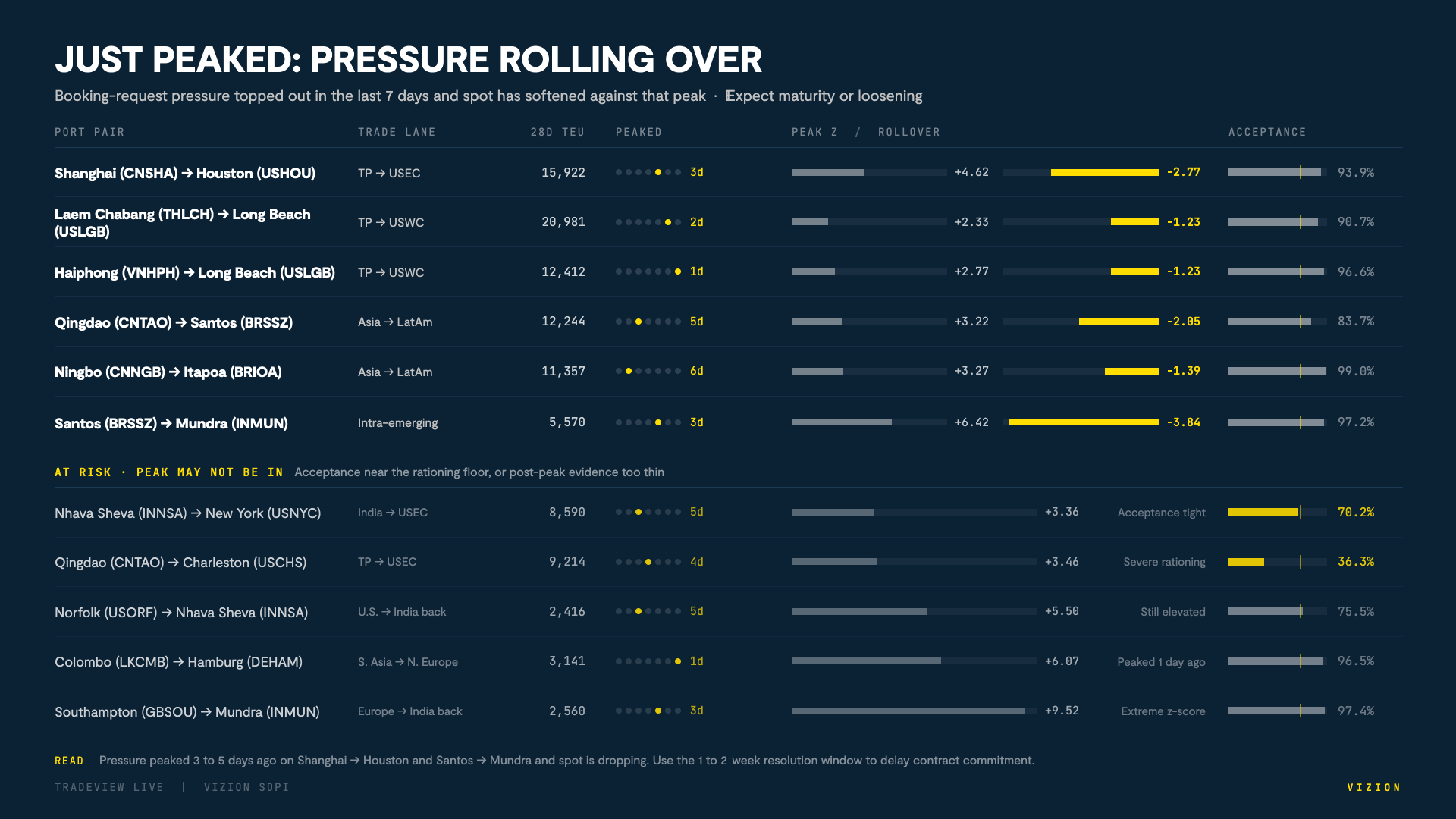
Just peaked. Booking-request pressure topped out in the past week on Shanghai to Houston, Laem Chabang and Haiphong to Long Beach, Qingdao to Santos, Ningbo to Itapoa, and Santos to Mundra, and spot has since softened against that peak. Acceptance on these pairs is high, 84% to 99%, which is part of why they are rolling over: when carriers are accepting at that level, supply and demand are converging rather than spreading apart. Expect maturity or loosening, and use the one to two week resolution window before committing to contract rates. A second group is flagged at risk, where the peak may not be in. Qingdao to Charleston is the sharpest case, with acceptance at 36.3%.
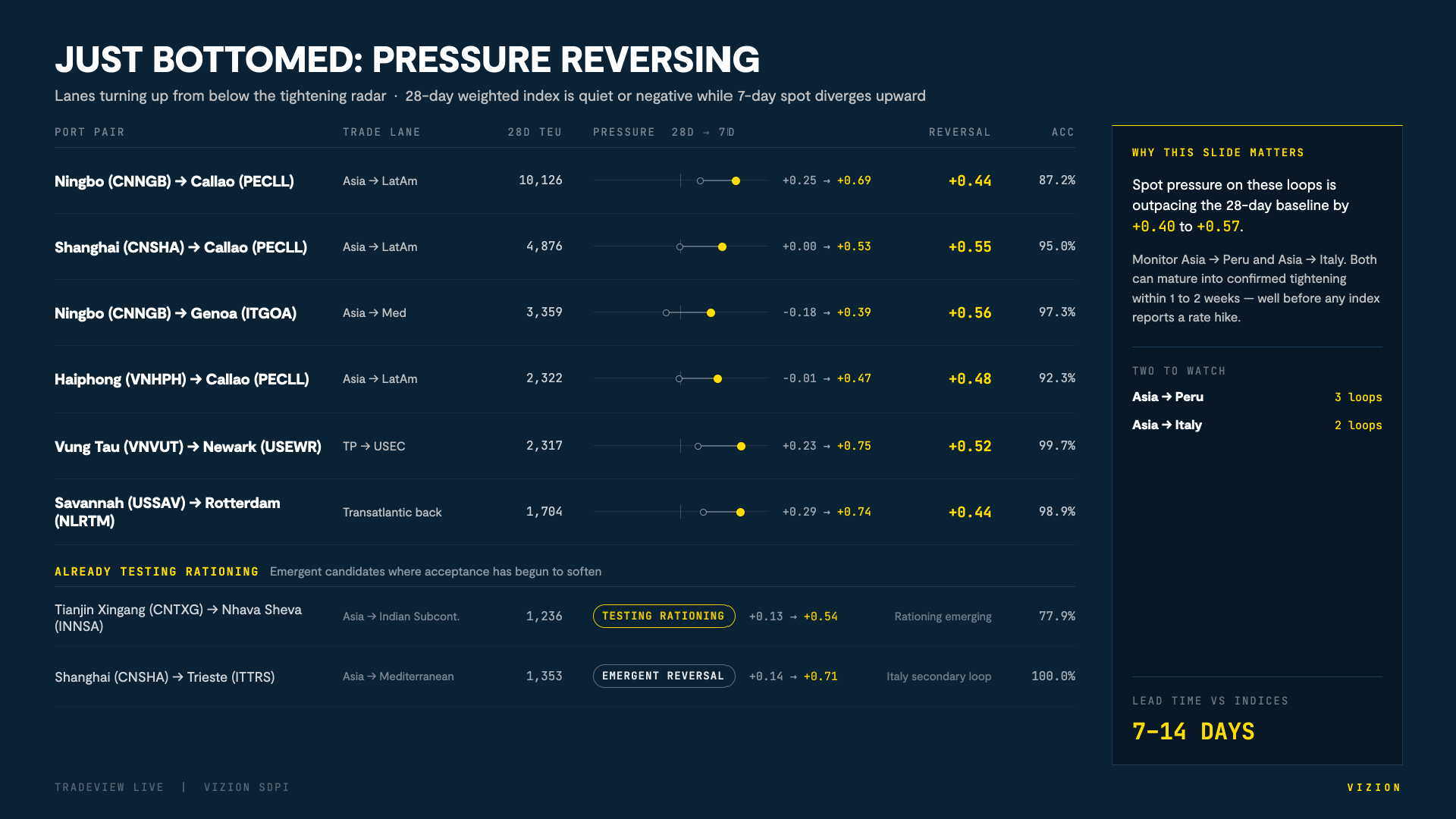
Just bottomed. The reverse pattern: pairs turning up from below the tightening radar, where the 28-day index is quiet or negative and 7-day spot has diverged upward by +0.40 to +0.57. Asia to Peru (Ningbo, Shanghai, and Haiphong to Callao) and Asia to Italy (Ningbo to Genoa, Shanghai to Trieste) are the two themes. Ningbo to Genoa is worth a look for anyone routing to North Europe through Italy. These are lower-volume pairs and will not apply to everyone, but they can mature into confirmed tightening within one to two weeks, before any rate index reports the move.
What to do in the next 14 days

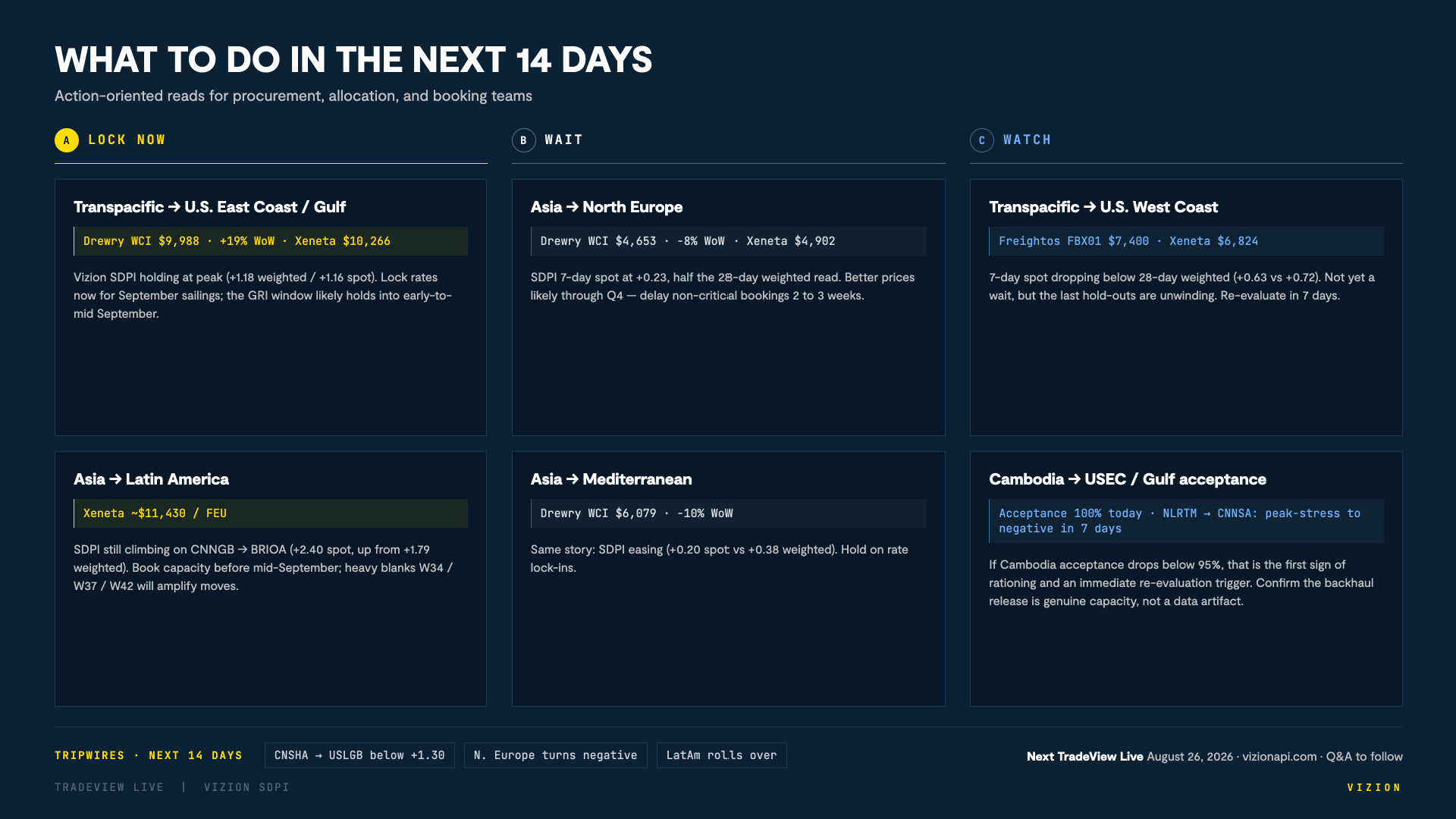
Lock now. Transpacific to US East Coast and Gulf, where SDPI is holding at peak and the GRI window likely runs into mid-September. Asia to Latin America, where heavy blank sailings in weeks 34, 37, and 42 will amplify any move. Book before mid-September.

Wait. Asia to North Europe and Asia to Mediterranean. Spot pressure is running at roughly half the weighted read. Delay non-critical bookings two to three weeks and let rates float.

Watch. Transpacific to US West Coast, re-evaluate in seven days. Cambodia to US East Coast and Gulf: if acceptance out of Phnom Penh drops below 95%, that is the first sign of rationing.
Where to get it

SDPI is available now via API and data share, and through tactical recommendations from Vizion's analyst team. It is coming to the BoxTrack application shortly, where BoxTrack customers will be able to read pressure on their own lanes directly in the UI. If you want the index read on the port pairs you actually ship, request a demo and we will run it live.

Get the Most Advanced Visibility into the Journey of Your Ocean and Rail Containers

Talk to one of our supply chain experts to get started now.

Talk to an Expert

Thank you for your submission!

A member of the Vizion team will be in touch shortly.
Oops! Something went wrong while submitting the form.

Talk to an Expert

Thank you for your submission!

A member of the Vizion team will be in touch shortly.
Oops! Something went wrong while submitting the form.
close modal icon

Book a Demo

Are you ready to experience the many benefits of container visibility? Schedule a VIZION API demo today.

Thank you for your submission!

A member of the Vizion team will be in touch shortly.
Oops! Something went wrong while submitting the form.
close modal icon

Vizion SDPI: A 7 to 14 Day Head Start on Ocean Freight Pressure

August 20, 2026

For a year and a half, TradeView has reported what is being booked, where it is going, and how volumes compare to last year. That data answers the "what" question well. It answers the "so what" question less well. A shipper looking at a lane that grew 20% still has to guess whether they will get an allocation next week, and whether the rate quoted today will hold.

The Supply-Demand Pressure Index (SDPI) is built for the second question. It is a daily pressure score for every origin-destination pair in the ocean freight network, benchmarked to a 12-month rolling baseline. For the read below we scored the top 1,000 port pairs by TEU volume, roughly 366,000 booking rows per day, and recalculated daily.

How the index works

Demand is the booking-request volume flowing into a port pair. Supply is a proprietary blend of several inputs: ocean service capacity and vessel assignments, carrier acceptance rates, booking modification rates, and the behavior patterns of different party types across geographies. The score publishes as two reads, a 28-day weighted index and a 7-day spot index. The gap between them tells you which direction a lane is moving.

Three operating thresholds: above +0.45 is severe stress, where carriers ration capacity, roll bookings, and add emergency surcharges. +0.30 to +0.45 is tightening, where demand outpaces vessel allocations and spot rates begin to firm. Below +0.30 is softening.

The piece most rate indices do not have is carrier acceptance. Acceptance confirms pressure, but it lags it. A lane with high pressure and perfect acceptance is an early warning. A lane where acceptance has broken below roughly 72% is a confirmed squeeze. That lag is the window, and in our data SDPI has moved 7 to 14 days ahead of the major rate indices. Ningbo to Newark is the worked example: pressure rose first, and acceptance broke the floor a week later, falling 12.8 points to 50.9%.

The first read: easing, with pockets of stress

The market is loosening. 77.8% of tracked capacity sits in a loosening vector, 14.0% is stable, and 8.2% is climbing. That loosening share covers 3,148,000 TEU of 28-day booking volume. Rates on the big east-west lanes have flattened or started to fall, and the posture for North Europe, the Mediterranean, and most Transpacific loops is to delay non-critical bookings.

Three lanes moved against that grain.

Asia to Latin America East Coast is confirmed tightening. Carriers are actively rationing space and pushing bookings onto spot lists, with Xeneta reading $11,430/FEU. Reshuffled service capacity and blank sailings have concentrated the pressure here, and the Panama Canal draft restrictions announced this month are a further factor to watch.

Indian Subcontinent to US East Coast is an early reversal. The 7-day spot read peaked at +1.74 against a 28-day weighted read of +0.76, and that spike preceded the August 15 peak-season surcharge of $5,650/FEU from Hapag-Lloyd and CMA CGM. If your allocations on this lane matter, lock slots at today's terms rather than wait for the easing to arrive.

Asia to North Europe and Mediterranean are easing. The Drewry Shanghai to Rotterdam spot fell 8% to $4,653/FEU with acceptance above 85%. This is where the delay posture pays.

Lane by lane

Every major loop with an active stage change, sorted by 28-day booking volume. Read the two right-hand columns together: when the 7-day spot is below the 28-day weighted, pressure is easing.

Transpacific to US East Coast is the largest lane still above the severe-stress line on both reads, +1.18 weighted and +1.16 spot. It is holding at peak rather than falling. Transpacific to US West Coast has started to turn, with spot (+0.63) now below weighted (+0.72). Intra-Asia, the largest lane by volume at 920,000 TEU, is neutral and drifting lower. Asia to West Africa is confirmed tightening and Asia to Latin America West Coast is maturing. Twenty neutral loops covering 784,000 TEU had no stage change and are left off.

Port pairs that moved

Trade lanes are the right unit for a market summary. They are the wrong unit for a booking decision. A shipper moving Qingdao to Buenos Aires does not care that Asia to Latin America is "tightening" in aggregate. They care whether their carrier is accepting bookings this week.

Tightening. Ningbo to Newark, Qingdao to Buenos Aires, Shekou to La Guaira, Qingdao to Itapoa, and Qingdao to Lekki are confirmed: carrier acceptance sits between 50% and 63%, well below the rationing floor. Mundra to New York is maturing, with acceptance at 73.4% and down 14.1 points in the past week. Expect rolled bookings and heightened rates on all six. Below them sit the early warnings: Phnom Penh to Houston, Mobile, and Norfolk, plus Shanghai to Houston and Shanghai to Long Beach, all carrying very high demand pressure while acceptance still runs at 95% to 100%. That combination is the first stage of the tightening path. Cambodia is the one to watch; combined with Vietnam, its export volume to the US now approaches what China sends.

Loosening. Rotterdam to Nansha, Shanghai to Le Havre, Shanghai to Santos, Antwerp to Ashdod, Ningbo to Iquique, and Ningbo to Laem Chabang are confirmed, with acceptance above 93%. If you are stuck on Qingdao to Buenos Aires and have flexibility on inland routing, Shanghai to Santos is loosening with acceptance at 100%. The loose-early group is the caution: Jeddah to Singapore, Shekou to Lazaro Cardenas, and three Vung Tau corridors show falling pressure, but acceptance is still between 66% and 80%. Carriers are still rolling cargo there, so do not treat space as free yet.

Just peaked. Booking-request pressure topped out in the past week on Shanghai to Houston, Laem Chabang and Haiphong to Long Beach, Qingdao to Santos, Ningbo to Itapoa, and Santos to Mundra, and spot has since softened against that peak. Acceptance on these pairs is high, 84% to 99%, which is part of why they are rolling over: when carriers are accepting at that level, supply and demand are converging rather than spreading apart. Expect maturity or loosening, and use the one to two week resolution window before committing to contract rates. A second group is flagged at risk, where the peak may not be in. Qingdao to Charleston is the sharpest case, with acceptance at 36.3%.

Just bottomed. The reverse pattern: pairs turning up from below the tightening radar, where the 28-day index is quiet or negative and 7-day spot has diverged upward by +0.40 to +0.57. Asia to Peru (Ningbo, Shanghai, and Haiphong to Callao) and Asia to Italy (Ningbo to Genoa, Shanghai to Trieste) are the two themes. Ningbo to Genoa is worth a look for anyone routing to North Europe through Italy. These are lower-volume pairs and will not apply to everyone, but they can mature into confirmed tightening within one to two weeks, before any rate index reports the move.

What to do in the next 14 days

Lock now. Transpacific to US East Coast and Gulf, where SDPI is holding at peak and the GRI window likely runs into mid-September. Asia to Latin America, where heavy blank sailings in weeks 34, 37, and 42 will amplify any move. Book before mid-September.

Wait. Asia to North Europe and Asia to Mediterranean. Spot pressure is running at roughly half the weighted read. Delay non-critical bookings two to three weeks and let rates float.

Watch. Transpacific to US West Coast, re-evaluate in seven days. Cambodia to US East Coast and Gulf: if acceptance out of Phnom Penh drops below 95%, that is the first sign of rationing.

Where to get it

SDPI is available now via API and data share, and through tactical recommendations from Vizion's analyst team. It is coming to the BoxTrack application shortly, where BoxTrack customers will be able to read pressure on their own lanes directly in the UI. If you want the index read on the port pairs you actually ship, request a demo and we will run it live.

Talk to an Expert

Book A Demo

Are you ready to experience the many benefits of container visibility? Schedule a VIZION API demo today.

close icon
Only valid business email addresses.
Please include country code.
Thank you! Your submission has been received!
Oops! Something went wrong while submitting the form.