Back to Resources

Cargo and Ship Tracking Finder: How Real-Time Vessel Tracking Transforms Logistics

May 15, 2025

What’s the cost of not knowing where your cargo really is?

In global logistics, even a two-hour delay at sea can throw off an entire delivery schedule, increase demurrage charges, and damage customer trust. Yet despite billions invested in supply chains, many businesses still depend on static updates or fragmented tools to track vessels.

A modern vessel finder changes that. It gives you real-time visibility into ship movement, port congestion, and route disruptions, before they turn into late fees or customer complaints.

Companies with end-to-end visibility are more likely to improve on-time delivery and reduce logistics costs.

What is a Cargo and Ship Tracking Finder?

For most teams in logistics, knowing where a shipment is right now is not enough. The real question is: where is the vessel carrying it, and how soon will it reach the port? That’s where a cargo and ship tracking finder comes in.

A vessel finder is a tool that gives you real-time location data for ships in transit. It tells you where a vessel is, where it’s headed, how fast it’s moving, and when it’s expected to arrive. 

But the best tracking systems go beyond that, they turn raw location signals into structured data you can actually use.

Must read: How to Track a Container: Beyond the Basics

Benefits of Real-Time Cargo and Ship Tracking Finder
When you can see exactly where your cargo is, and what might delay it,  you stop reacting and start planning. That’s the real value of a modern ship tracking finder.

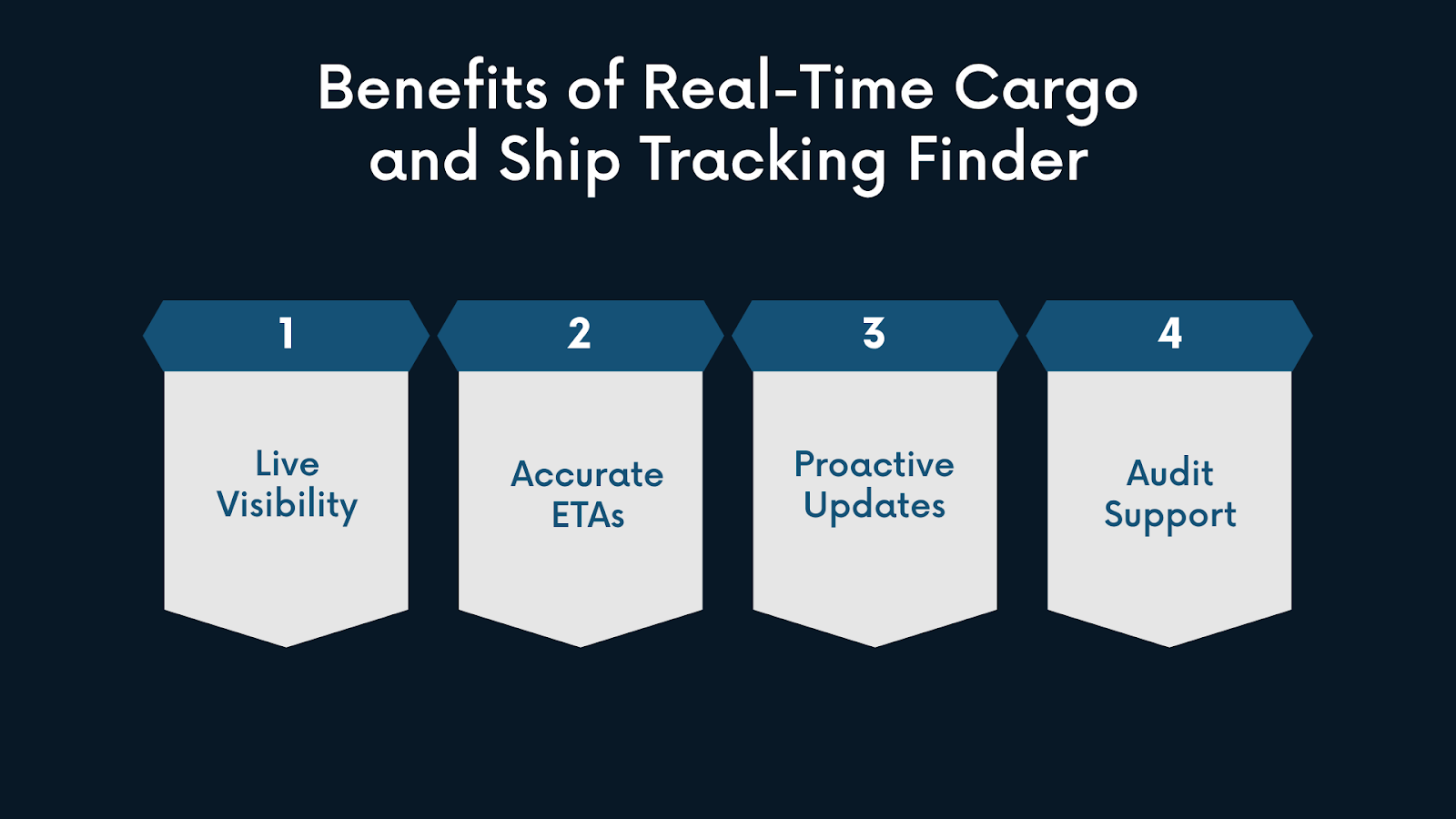
  • Live Visibility: Know exactly where a vessel is, how it’s moving, and when delays might impact your shipment, all in real time.
  • Accurate ETAs: Predict arrivals based on actual vessel behavior and port conditions, not outdated schedules or static estimates.
  • Proactive Customer Updates: Keep customers informed with accurate, timely shipment status, no check calls or manual digging required.
  • Compliance and Audit Support: Track vessel movements across global lanes with a reliable digital trail that supports audits and regulatory requirements.

Must read: Benefits of Real-time Shipment Tracking

How Vessel Finder Technology Works?

Modern vessel tracking relies on a stack of technologies working together to deliver real-time container visibility across global waters.

1. Automatic Identification System (AIS)

Commercial vessels continuously broadcast data like identity, position, speed, and course. These signals are picked up by land-based receivers near coastlines and by satellites in open water, forming the foundation of global vessel tracking.

2. Satellite AIS (S-AIS)

Satellite integration fills the gaps where land-based coverage ends. It enables continuous tracking in remote regions, ensuring logistics teams can monitor vessels throughout the entire voyage.

3. Data Aggregation and APIs

Raw AIS data alone isn’t enough. APIs collect, clean, and standardize tracking events so they can be used in real-world systems. This structured data powers accurate ETAs, real-time updates, and automation across supply chain platforms.

Vizion brings these layers together into a single, reliable stream of structured vessel and container tracking data. 

Must read: How Data Analytics Is Transforming Global Trade Decision-Making

Why is Vizion the Ideal Vessel Tracking Solution?

  • Real-time, structured tracking: Track up to 99% of global containerized shipments with clean, timestamped updates from over 240 carriers, ports, terminals, and AIS sources.
  • Seamless integration: Vizion connects directly to your TMS, ERP, or platform,  no scraping, no workarounds, just real-time visibility at scale.
  • Upstream booking data: With exclusive Dun and Bradstreet data, get visibility into shipping activity up to 90 days before container arrival.
  • Scalable and reliable: Handle thousands of shipments across multiple carriers without throttling or delay, built for fast-moving operations.

Conclusion

Vessel tracking is no longer just about seeing where a ship is. It’s about turning that visibility into faster responses, smarter decisions, and better customer experiences. The difference comes down to how accurate, structured, and accessible your data really is.

Vizion delivers that difference with real-time vessel and cargo tracking

If your team is still relying on scattered updates or manual tracking tools, it’s time to upgrade your visibility.

See how Vizion can simplify vessel tracking and strengthen your supply chain. Book a demo today.

Get the Most Advanced Visibility into the Journey of Your Ocean and Rail Containers

Talk to one of our supply chain experts to get started now.

Talk to an Expert

Thank you for your submission!

A member of the Vizion team will be in touch shortly.
Oops! Something went wrong while submitting the form.

Talk to an Expert

Thank you for your submission!

A member of the Vizion team will be in touch shortly.
Oops! Something went wrong while submitting the form.
close modal icon

Book a Demo

Are you ready to experience the many benefits of container visibility? Schedule a VIZION API demo today.

Thank you for your submission!

A member of the Vizion team will be in touch shortly.
Oops! Something went wrong while submitting the form.
close modal icon

Cargo and Ship Tracking Finder: How Real-Time Vessel Tracking Transforms Logistics

May 15, 2025

What’s the cost of not knowing where your cargo really is?

In global logistics, even a two-hour delay at sea can throw off an entire delivery schedule, increase demurrage charges, and damage customer trust. Yet despite billions invested in supply chains, many businesses still depend on static updates or fragmented tools to track vessels.

A modern vessel finder changes that. It gives you real-time visibility into ship movement, port congestion, and route disruptions, before they turn into late fees or customer complaints.

Companies with end-to-end visibility are more likely to improve on-time delivery and reduce logistics costs.

What is a Cargo and Ship Tracking Finder?

For most teams in logistics, knowing where a shipment is right now is not enough. The real question is: where is the vessel carrying it, and how soon will it reach the port? That’s where a cargo and ship tracking finder comes in.

A vessel finder is a tool that gives you real-time location data for ships in transit. It tells you where a vessel is, where it’s headed, how fast it’s moving, and when it’s expected to arrive. 

But the best tracking systems go beyond that, they turn raw location signals into structured data you can actually use.

Must read: How to Track a Container: Beyond the Basics

Benefits of Real-Time Cargo and Ship Tracking Finder

When you can see exactly where your cargo is, and what might delay it,  you stop reacting and start planning. That’s the real value of a modern ship tracking finder.

  • Live Visibility: Know exactly where a vessel is, how it’s moving, and when delays might impact your shipment, all in real time.
  • Accurate ETAs: Predict arrivals based on actual vessel behavior and port conditions, not outdated schedules or static estimates.
  • Proactive Customer Updates: Keep customers informed with accurate, timely shipment status, no check calls or manual digging required.
  • Compliance and Audit Support: Track vessel movements across global lanes with a reliable digital trail that supports audits and regulatory requirements.

Must read: Benefits of Real-time Shipment Tracking

How Vessel Finder Technology Works?

Modern vessel tracking relies on a stack of technologies working together to deliver real-time container visibility across global waters.

1. Automatic Identification System (AIS)

Commercial vessels continuously broadcast data like identity, position, speed, and course. These signals are picked up by land-based receivers near coastlines and by satellites in open water, forming the foundation of global vessel tracking.

2. Satellite AIS (S-AIS)

Satellite integration fills the gaps where land-based coverage ends. It enables continuous tracking in remote regions, ensuring logistics teams can monitor vessels throughout the entire voyage.

3. Data Aggregation and APIs

Raw AIS data alone isn’t enough. APIs collect, clean, and standardize tracking events so they can be used in real-world systems. This structured data powers accurate ETAs, real-time updates, and automation across supply chain platforms.

Vizion brings these layers together into a single, reliable stream of structured vessel and container tracking data. 

Must read: How Data Analytics Is Transforming Global Trade Decision-Making

Why is Vizion the Ideal Vessel Tracking Solution?

  • Real-time, structured tracking: Track up to 99% of global containerized shipments with clean, timestamped updates from over 240 carriers, ports, terminals, and AIS sources.
  • Seamless integration: Vizion connects directly to your TMS, ERP, or platform,  no scraping, no workarounds, just real-time visibility at scale.
  • Upstream booking data: With exclusive Dun and Bradstreet data, get visibility into shipping activity up to 90 days before container arrival.
  • Scalable and reliable: Handle thousands of shipments across multiple carriers without throttling or delay, built for fast-moving operations.

Conclusion

Vessel tracking is no longer just about seeing where a ship is. It’s about turning that visibility into faster responses, smarter decisions, and better customer experiences. The difference comes down to how accurate, structured, and accessible your data really is.

Vizion delivers that difference with real-time vessel and cargo tracking

If your team is still relying on scattered updates or manual tracking tools, it’s time to upgrade your visibility.

See how Vizion can simplify vessel tracking and strengthen your supply chain. Book a demo today.

Talk to an Expert

Book A Demo

Are you ready to experience the many benefits of container visibility? Schedule a VIZION API demo today.

close icon
Only valid business email addresses.
Please include country code.
Thank you! Your submission has been received!
Oops! Something went wrong while submitting the form.